How Social Media Marketing Automation Can Boost Productivity

How Social Media Marketing Automation Can Boost Productivity

If keeping up with posting, engagement, and performance tracking is taking too much time, social media automation can take some of that work off your plate.

It can help with repetitive tasks such as scheduling posts, organizing content, monitoring activity, and collecting performance data. That gives you more time to focus on strategy, creative work, and conversations that still need a human touch.

In this guide, we’ll look at which social media tasks are worth automating, where automation can save the most time, and which tools can help you simplify your content process.

SocialBee logo featuring a stylized yellow bee icon on a dark hexagonal background.
SocialBee – Social media management tool
Social media management tool
Download the social media marketing plan!

We’re SocialBee LABS SRL, part of WebPros. We use the information you provide to share relevant content & updates, as outlined in our Privacy Policy. You can opt out anytime.

Short Summary

  • Social media automation can handle repetitive tasks such as scheduling, content organization, reporting, engagement monitoring, and customer support.
  • The biggest benefits are time savings, more consistent publishing, easier reporting, and less manual work across multiple platforms.
  • Content creation can be simplified with features such as post customization, content curation, RSS feed integration, visual tools, and AI generation.
  • Scheduling tools can help you plan content in advance and publish when your audience is more likely to be active.
  • Centralized analytics make it easier to compare performance, spot patterns, and adjust your content strategy.
  • Tools such as SocialBee, NapoleonCat, Later, StoryChief, and Loomly combine different automation features for publishing, engagement, analytics, and collaboration.

What Is Social Media Automation?

Social media automation is the use of software to handle repetitive tasks across your social media accounts.

This can include scheduling posts, organizing content, collecting performance data, monitoring engagement, and managing comments or messages.

By automating these routine tasks, you spend less time on day-to-day admin and more time on strategy, content creation, and conversations that need a human touch.

Why Should You Invest in a Social Media Automation Tool?

Social media automation is most useful when it removes repetitive work without taking control away from your team.

Here are the main benefits:

  • Save time and reduce costs: Tasks like scheduling, monitoring, and reporting don’t need to be handled manually every day. This can free up time for higher-value work, and reports show that businesses investing in automation tools can see a 14% increase in productivity.
  • Stay consistent across platforms: Planning and scheduling content in advance makes it easier to maintain a regular posting schedule and keep your messaging consistent across social networks.
  • Respond faster to your audience: Bringing comments and messages into one place makes it easier to spot conversations that need attention. This matters when more than 60% of U.S. consumers say they are likely to avoid buying from a brand they cannot contact.
  • Make better planning decisions: Automation tools can bring audience and content performance data together, helping you see what is working and adjust your strategy accordingly.
  • Reduce repetitive work as you grow: Managing more accounts, content, and conversations usually means more manual work. Automating repeatable tasks makes it easier to scale your social media efforts without increasing the workload at the same rate.

What Social Media Tasks Should You Automate?

Automation works best when it takes repetitive work off your plate without making your social media presence feel impersonal.

Used well, it can save time while still leaving room for genuine engagement with your audience.

Here are the social media tasks you should automate:

  1. Developing a successful social media strategy
  2. Streamlining the content creation process
  3. Social media post scheduling and publishing
  4. Centralizing data analysis
  5. Engaging across multiple social media platforms
  6. Using social media to provide customer support

1. Developing a Successful Social Media Strategy

A social media strategy usually involves deciding what to post, how often to publish, which platforms to focus on, and how to use performance data to improve over time.

The challenge is that this planning can take a lot of manual work before you even start creating content.

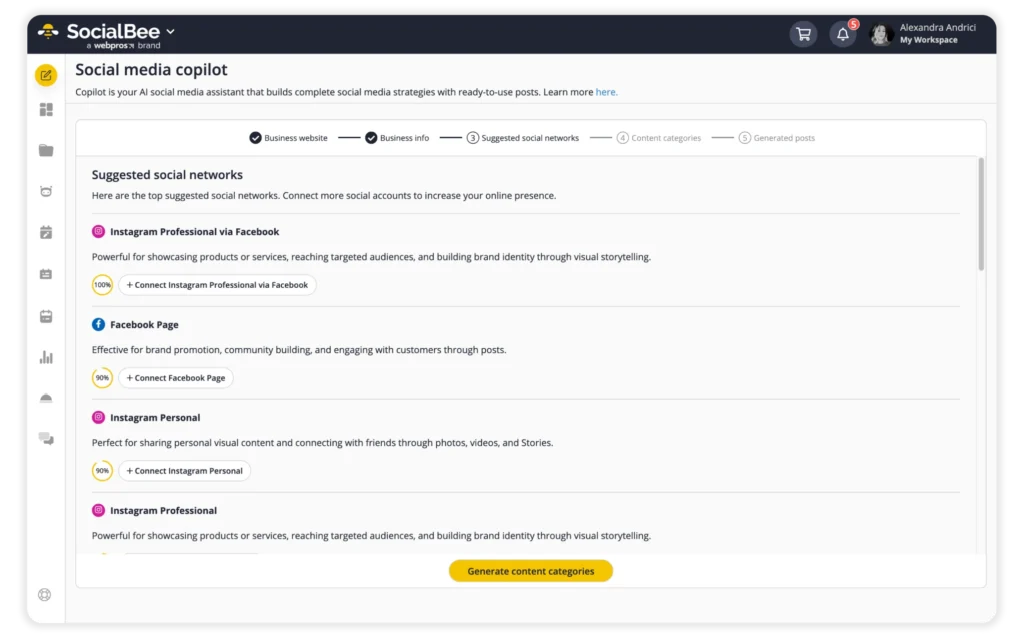
This is where AI can help. SocialBee’s Copilot builds a social media strategy based on your answers to eight questions about your business, audience, and goals.

Let SocialBee create a social media strategy customized for your brand instantly.

Start your 14-day trial now!

It can then support your social media strategy with:

  • Platform recommendations: Get suggestions for the social networks that best match your audience.
  • Content ideas: Generate content categories and ideas based on your brand and audience.
  • Posting schedule suggestions: See recommended times for publishing based on when your audience is more likely to be active.
  • AI-generated posts: Get a selection of ready-to-edit post ideas based on your strategy.

2. Streamlining the Content Creation Process

Automation can make content creation easier.

It brings useful tools and resources into one place. That can include content libraries, stock images, design tools, AI features, and shared team workspaces.

Here are some of the best ways to streamline the content creation process with social media automation:

  • Content personalization: Create different versions of the same post without switching between platforms. Adjust captions, visuals, and hashtags for each network.
  • Team collaboration: Work in a shared space with your team. Create, edit, leave notes, and approve content in one place.
  • Content curation: Save articles, videos, and other useful resources inside your social media tool. This makes them easier to organize and schedule later.
  • RSS feed integration: Connect multiple RSS feeds and automatically save new articles into a content category. Then add a caption manually or generate one with AI.
  • Hashtag research: Get hashtag suggestions that match your content. This can make it easier to improve discoverability.
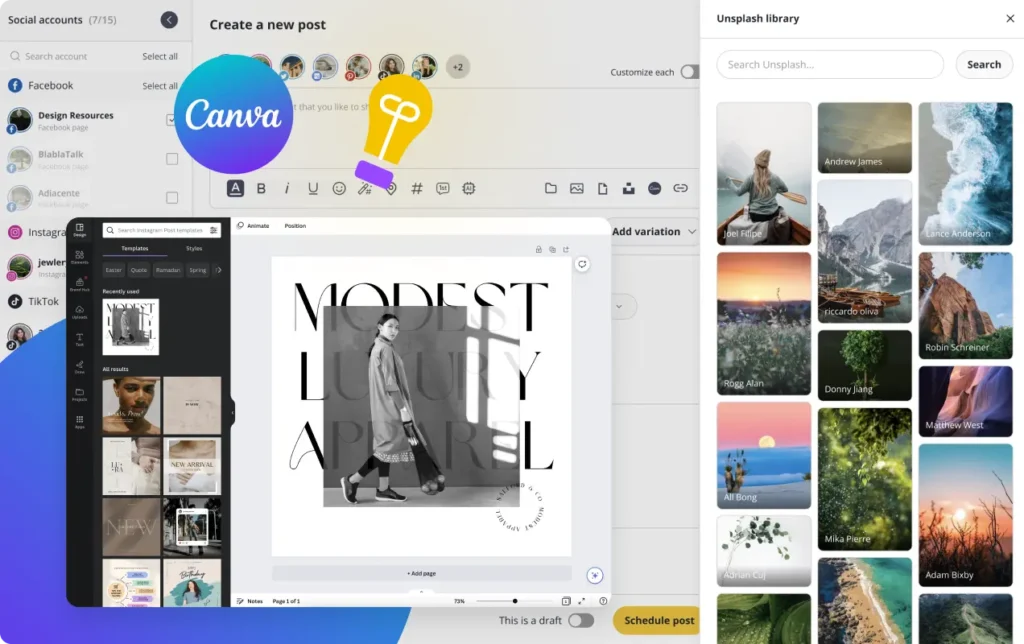
  • Visual content creation: Use built-in integrations with design and image tools. This lets you create or source visuals without leaving the platform.
  • AI content generation: Use an AI post generator to turn prompts into captions and visuals. You can then edit them to match your brand voice.
PRO TIP:

Want to spend less time creating social media content?

SocialBee brings these tasks into one place.

You can customize posts, collaborate with your team, curate content, connect RSS feeds, and get hashtag suggestions.

You can also use Canva, Unsplash, and GIPHY integrations. On top of that, SocialBee includes AI tools for generating captions and visuals.

3. Social Media Post Scheduling and Publishing

When you post matters.

So does how often you publish.

A consistent schedule helps you stay visible. It also makes it easier for your audience to know what to expect.

That’s where social media post scheduling becomes useful.

By planning content in advance, you can keep posts going out regularly across platforms. You also avoid having to publish manually every day.

This is especially helpful if you manage audiences in different time zones.

Timing matters too.

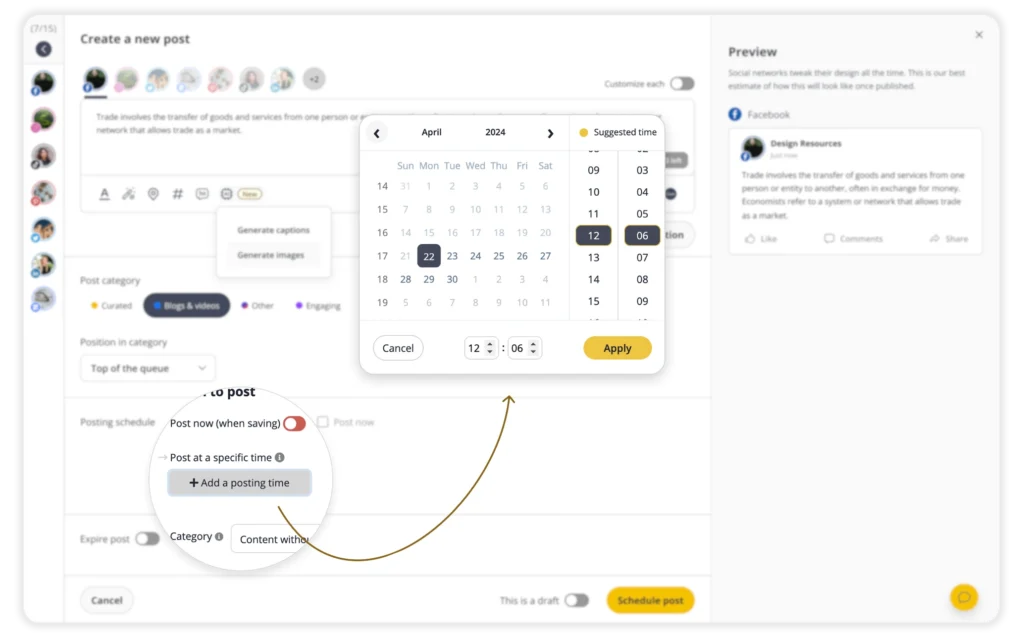
Tools like SocialBee can suggest the best posting times based on audience activity.

Schedule and publish content on all major social media platforms with SocialBee!
Start your 14-day free trial today!

With those insights, you can schedule content when more of your audience is likely to be online.

Here are the posting features to look for in a social media automation tool:

  • Multi-platform support: Manage publishing across the social networks you use.
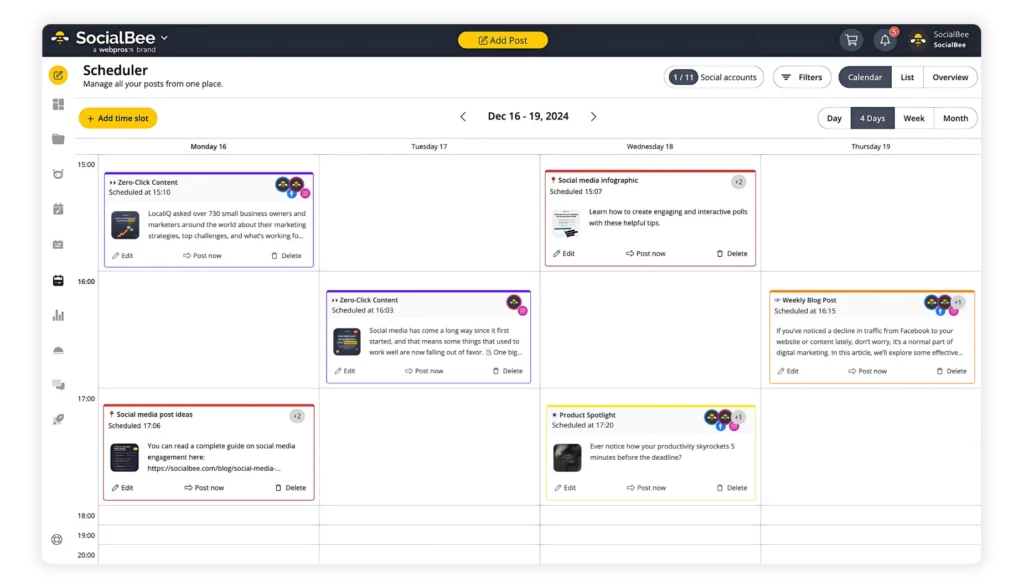
  • Visual content calendar: See what is scheduled, where it will appear, and when it will go live.
  • Bulk scheduling: Upload and schedule several posts at once.
  • Evergreen posting: Reshare useful content automatically when it still has value.
  • Platform-specific scheduling: Choose different publishing times for different networks.
  • Recommended posting times: Use audience activity data to guide when you publish.
  • Analytics: Track performance and use the results to improve future content.
  • Easy-to-use interface: Keep planning and scheduling simple, even across several accounts.
  • Content curation: Save and organize useful content for future posts.
  • Team collaboration: Plan, review, and schedule content with other team members.

4. Centralizing Data Analysis

Publishing content is only one part of social media management.

You also need to know what is working.

Automation tools can bring data from different accounts into one place. That makes it easier to track audience growth, content performance, and engagement without checking every platform separately.

In turn, centralized data gives you a clearer view of what is happening across your channels.

It can also help you build more cohesive social media marketing strategies.

Here’s how centralized analytics can support your marketing efforts:

  • Consolidate data: Gather performance data from the social accounts you manage in one place.
  • Identify trends: Spot which topics, formats, or posts consistently perform better than others.
  • Optimize posting times: Use audience activity data to see when people are most likely to be online.
  • Personalize content: Use audience insights to adapt content for different segments.
  • Measure performance: Track KPIs such as engagement rate, CTR, and conversions.
  • Generate reports: Turn performance data into reports you can share with your team or clients.
  • Improve over time: Use what you learn to test new formats, posting frequencies, or content ideas.
PRO TIP:

Did you know you can generate PDF social media reports with SocialBee?

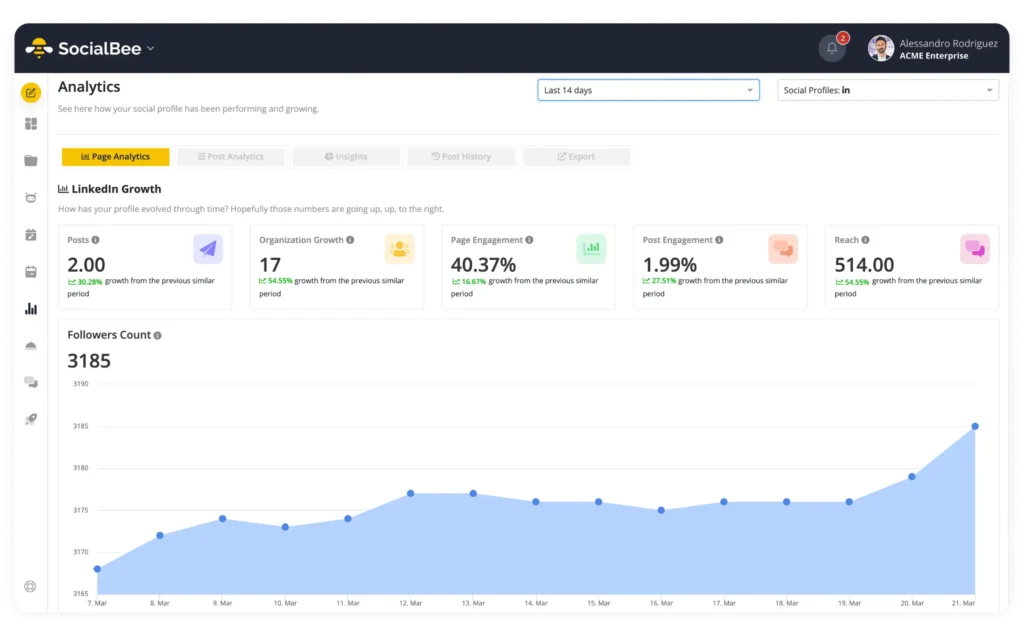
SocialBee brings your social media analytics into a clear, visual dashboard.

That means less time spent collecting data manually.

You can review audience demographics, page growth, post performance, and top-performing content.

From there, it becomes easier to spot gaps and decide what to adjust next.

5. Engaging Across Multiple Social Media Platforms

Once content is live, the next challenge is keeping up with the conversations around it.

Messages, comments, and mentions can quickly become scattered across different platforms.

As a result, replies take longer, and important interactions are easier to miss.

Automation can make that easier to manage.

Here’s how social media marketing automation can help you handle engagement across multiple platforms:

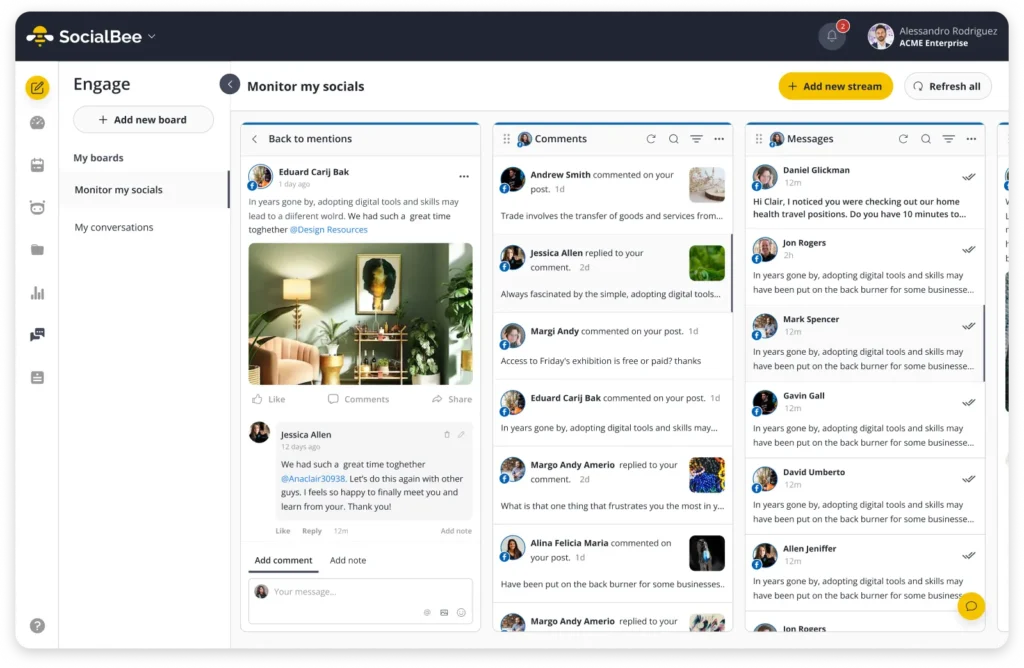
  • Unified messaging: Bring messages, comments, and mentions from different accounts into one dashboard.
  • Message filtering: Sort conversations by platform, date, or status so you can focus on what needs attention first.
  • Team collaboration: Assign conversations, leave internal notes, and mark messages as handled.
  • Notifications: Stay updated when new mentions or messages come in.
PRO TIP:

SocialBee’s Engage Module brings mentions, comments, and direct messages into one place.

That makes it easier to monitor conversations, respond to feedback, and handle requests without switching between platforms.

Engage with your audience from a centralized dashboard: SocialBee.

Start our 14-day trial now!

With everything in one dashboard, your team can spend less time jumping between apps.

More importantly, it becomes easier to keep track of conversations and respond consistently across channels.

6. Using Social Media to Provide Customer Support

Social media has become an important customer support channel.

People use it to ask questions, report problems, and request help. That means brands need a clear way to respond quickly and consistently.

With the right setup, social media can support fast and effective customer support.

Unlike traditional support channels, social platforms are active around the clock. As a result, customer questions can come in at any time.

Here’s an example from @IlluminateInkStudio’s Facebook account:

Customer support on social media

A simple framework can help your team decide what to do next.

Here are a few options:

The R.A.P.I.D. Framework

  • Recognize: Identify new questions, mentions, and messages.
  • Acknowledge: Let customers know their message has been received.
  • Prioritize: Sort requests by urgency, sentiment, or topic.
  • Investigate: Send the issue to the right person or team.
  • Resolve: Provide a solution and keep the customer updated.
  • Delight: Look for opportunities to go beyond the basic resolution.

The A.C.T. Framework

  • Automate: Use automation for common questions and brand monitoring.
  • Communicate: Share expected response times and support availability.
  • Track: Monitor customer conversations across social platforms.

The S.E.R.V.E. Framework

  • Speed: Respond as quickly as possible.
  • Engagement: Keep replies personal and human.
  • Responsiveness: Address questions and feedback without unnecessary delays.
  • Value: Give customers useful information or a clear solution.
  • Empathy: Show that you understand the customer’s concern.

The C.A.R.E. Framework

  • Capture: Collect customer questions and feedback from your social channels.
  • Analyze: Look for recurring issues, sentiment, and common themes.
  • Respond: Provide a relevant and personalized answer.
  • Evaluate: Review customer feedback and use it to improve your support process.

The A.C.T.I.O.N. Framework

  • Automation: Use tools to handle monitoring, routing, and simple responses.
  • Collaboration: Make it easy for support teams to work together.
  • Transparency: Be clear about response times, next steps, and resolutions.
  • Innovation: Adjust your support approach as customer needs change.
  • Optimization: Use feedback and KPIs to improve the process.
  • Nurture: Continue building the customer relationship after the issue is resolved.

These frameworks overlap in several areas.

Most of them come down to the same core principles: respond quickly, route issues correctly, communicate clearly, and keep the interaction human.

PRO TIP: Use automation to identify customers who have expressed dissatisfaction or reported a problem on social media.

From there, follow up with a personalized message. Offer help, address the issue, and show your commitment to customer satisfaction.

Best Social Media Automation Tools to Boost Your Productivity

Social media automation tools can take repetitive work off your plate.

Depending on the platform, they can help with scheduling, content creation, engagement, reporting, and team collaboration.

That makes it easier to manage day-to-day tasks while still leaving time to improve your social media strategy.

Here are some of the best social media automation tools to consider:

Check out this table to learn how they compare in terms of features:
Features SocialBee NapoleonCat Later StoryChief Loomly
Supported Platforms Facebook X (Twitter) Instagram LinkedIn Pinterest Google Business Profile TikTok YouTube Bluesky Facebook X (Twitter) Instagram LinkedIn Google Business Profile TikTok YouTube Facebook X (Twitter) Instagram LinkedIn Pinterest Google Business Profile TikTok Facebook X (Twitter) Instagram LinkedIn  Google Business Profile TikTok Facebook X (Twitter) Instagram LinkedIn Pinterest Google Business Profile TikTok Snapchat
AI-Powered Content Generation

✅

❌ ❌ ✅

❌

Content Categories ✅ ✅ ❌ ✅ ❌
Content Scheduling ✅ ✅ ✅ ✅ ❌
Bulk Scheduling ✅ ✅ ✅ ✅ ✅
Evergreen Posting ✅ ❌ ❌ ✅ ✅
Social Media Calendar ✅ ✅ ✅ ✅ ❌
RSS Feed Import ✅ ✅ ❌ ❌ ✅
Hashtag Generator ✅ ❌ ✅ ❌ ✅
Visual Integrations (e.g., Canva, Unsplash, GIPHY) ✅ ❌ ✅ ❌ ❌
Multiple Shortlink Tools ✅ ✅ ❌ ❌ ✅
Social Media Analytics ✅ ✅ ✅ ✅ ✅
Export PDF Reports ✅ ✅ ❌ ✅ ✅
Team Collaboration ✅ ✅ ❌ ❌ ✅
Multiple Workspaces ✅ ✅ ❌ ✅ ❌
Social Media Inbox ✅ ✅ ❌ ❌ ✅
Free Trial 14-day free trial 14-day free trial 14-day free trial 7-day free trial 14-day free trial
Starting Price $29/month $32/month $25/month per channel €30/month  $42/month

1. SocialBee

SocialBee brings content creation, scheduling, engagement, analytics, and collaboration into one platform.

That makes it easier to manage more of your social media work without switching between several tools.

  • Platform support: Manage Facebook, Instagram, Threads, X (Twitter), LinkedIn, Pinterest, Bluesky, Google Business Profile, TikTok, and YouTube from one place.
  • Visual integrations: Create or source visuals with Canva, Unsplash, and GIPHY without leaving SocialBee.
  • AI features: Generate captions and images with AI. You can also use AI to support your social media strategy.
  • Content management: Organize posts into categories, schedule them in advance, and recycle evergreen content.
  • Post customization: Adjust captions, visuals, and other post details for each social network.
  • Scheduling and previewing: Use the calendar to plan upcoming posts. You can also preview how content will appear across platforms.
  • Collaboration: Work with your team in shared spaces built for social media collaboration.
  • Analytics: Track post performance and review engagement data. This makes it easier to see what is working.
  • Engagement tools: Manage comments, mentions, and messages from SocialBee instead of switching between platforms.

2. NapoleonCat

NapoleonCat is especially useful for teams that manage a high volume of comments, messages, and social interactions.

Alongside publishing and analytics, it puts a strong emphasis on moderation and inbox management.
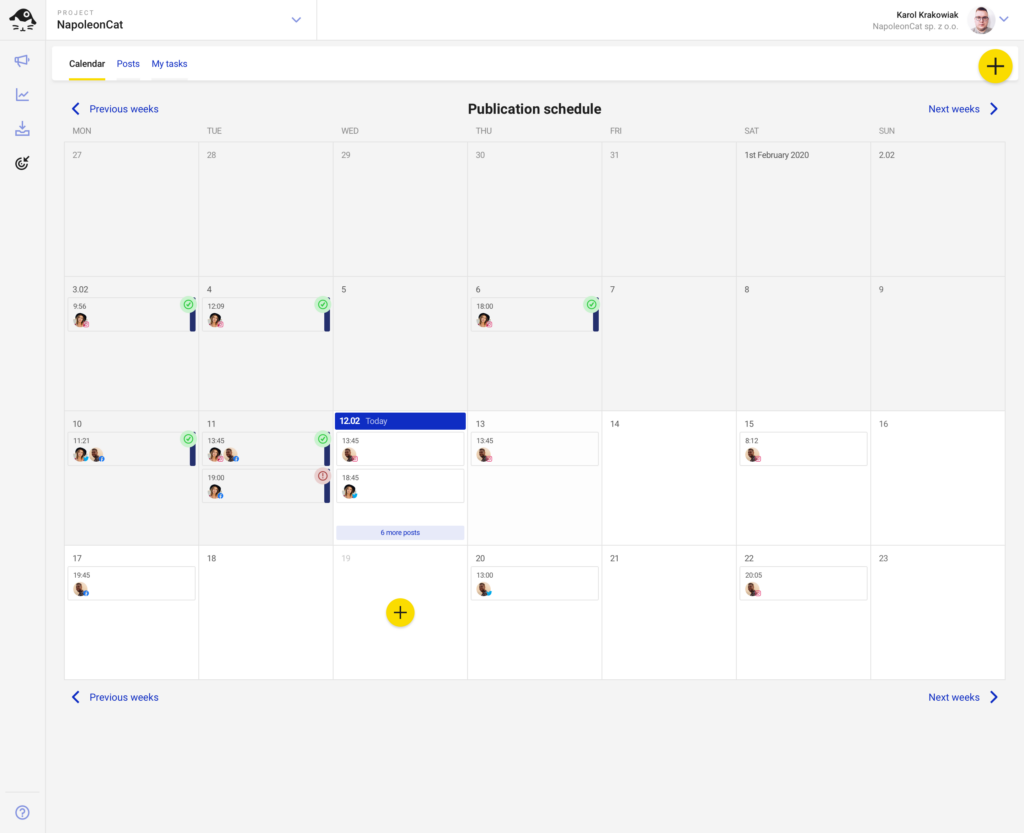
publishing tool calendar view napoleoncat

  • Scheduling and publishing: Plan and publish posts across multiple social media platforms.
  • Automated moderation: Set up rules to handle repetitive comment-management tasks and reduce manual work.
  • Social inbox: Bring messages and comments from different platforms into one place. This makes it easier to keep up with customer questions and feedback.
  • Analytics: Review audience engagement, sentiment, and competitor performance. From there, you can use the data to adjust your social media strategy.

3. Later

Later is built around visual content planning, which makes it a natural fit for brands that rely heavily on image-first platforms such as Instagram and Pinterest.

Its drag-and-drop calendar makes it easy to see how upcoming content is laid out before it goes live.
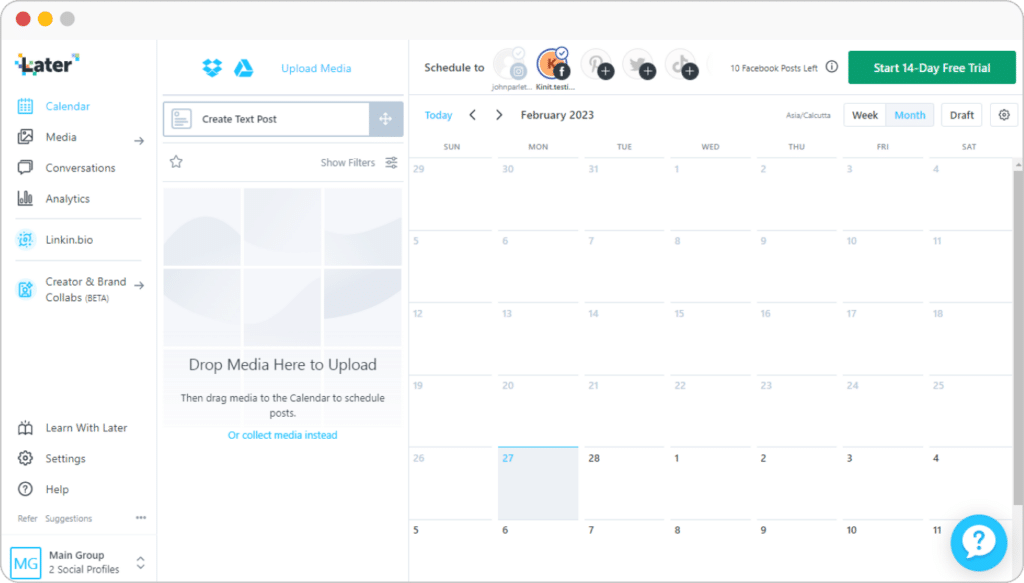
later dashboard

  • Visual scheduling: Plan and arrange posts in a calendar so you can see your content mix at a glance.
  • Media library: Store and organize images and videos for easier reuse when creating future posts.
  • Instagram-focused tools: Schedule Instagram Stories and manage other publishing tasks from the same platform.
  • Linkin.bio: Turn Instagram traffic into website visits by connecting posts to destination links.

Because the platform puts so much emphasis on visuals, it can be especially useful for teams that want a more visual way to plan and organize content.

4. StoryChief

StoryChief is a content marketing platform that also includes social media publishing.

That makes it a better fit for teams that want to manage social content alongside other types of marketing content.
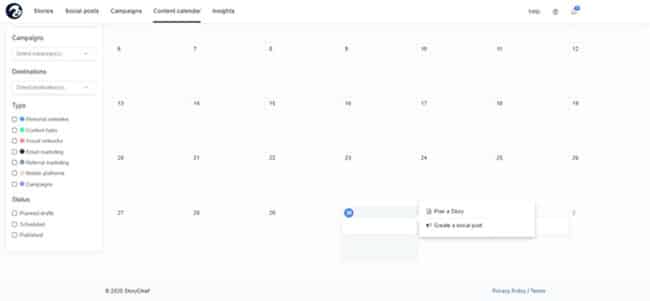
StoryChief calendar

  • Collaborative workspace: Create, edit, and review content with your team in one place.
  • Social publishing: Schedule and publish posts directly to connected social media platforms.
  • Multi-channel distribution: Manage social content as part of a wider content marketing plan, instead of treating it as a separate task.
  • Performance insights: Review how social posts perform across channels. Then use those results to refine future content.

5. Loomly

Loomly is a good fit for teams that want a straightforward way to plan, create, and schedule social content.

It also helps when you’re short on ideas. The platform includes post suggestions and prompts that can give you a starting point instead of leaving you with a blank calendar.
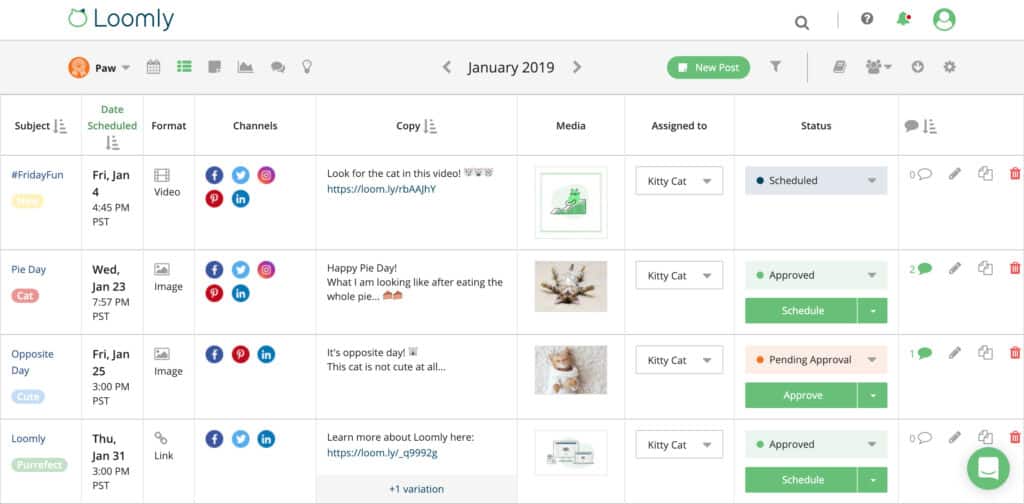
loomly dashboard

  • Content planning: Organize upcoming posts across your social channels and see what’s coming up.
  • Post ideas: Get suggestions when you need inspiration for what to publish next.
  • Editing tools: Make quick changes to posts before they go live.
  • Scheduling: Prepare content in advance and publish it automatically at the right time.
  • Analytics: See how your posts are performing and which content gets the strongest response.

Overall, Loomly keeps the process fairly simple. It covers the main steps from planning to publishing without making the setup feel overly complicated.

Frequently Asked Questions

1. Who Needs Social Media Automation Tools?

Social media automation tools can help anyone who spends too much time on repetitive social media tasks.

They’re especially useful for:

  • Small businesses that want to save time and stay consistent
  • Marketing agencies and social media managers handling several client accounts
  • Solopreneurs and entrepreneurs who don’t want to post everything manually
  • Larger companies managing content across several platforms

In short, if social media is taking up too much of your day, automation can help lighten the load.

2. How Can I Use AI in Digital Marketing?

Artificial intelligence (AI) can help with several everyday marketing tasks.

You can use it to:

  • Create and adapt social media posts
  • Find patterns in audience data
  • Improve targeting
  • Answer common customer questions with chatbots
  • Review campaign performance
  • Automate tasks like scheduling and reporting

AI works best as a helper.

It can speed up repetitive work, but you still need human input for strategy, creative choices, and more sensitive conversations.

3. How Do You Fully Automate Social Media?

You can automate a large part of social media management, but you probably shouldn’t automate everything.

A good place to start is with repetitive tasks such as:

  • Scheduling and publishing posts
  • Curating content
  • Setting up automatic replies for common questions
  • Tracking performance
  • Connecting your social tools with your CRM
  • Reviewing results and improving your setup over time

From there, keep people involved where judgment matters.

That includes strategy, creative work, and customer conversations that need a personal response.

Automate Your Social Media Presence with SocialBee!

Social media automation should make your work easier, not make your brand feel less human.

Start with the tasks that take up time every week, such as scheduling, reporting, organizing content, and managing messages.

Once those are handled, you have more time for the work that needs your attention.

That means better planning, stronger content, and more meaningful conversations with your audience.

If you want to bring more of those tasks into one place, start SocialBee’s 14-day free trial and see which parts of your social media management you can simplify first.
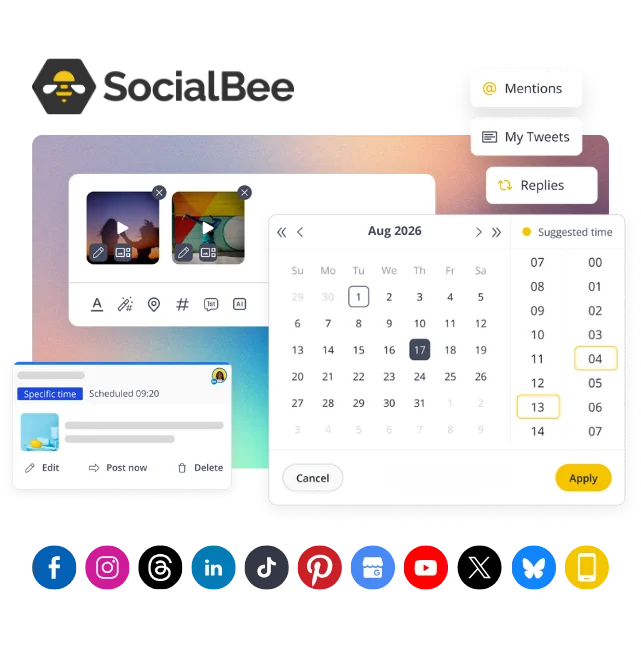

Automate Your Social Media Campaigns with SocialBee!
Create posts, publish, analyze, engage and collaborate, all from SocialBee.
Summarize this post

SocialBee

Social media management made simple

Join thousands of brands growing with SocialBee

Read the latest articles

Level up your social media marketing with exclusive resources delivered straight to your inbox

We’re SocialBee LABS SRL, part of WebPros. We use the information you provide to share relevant content and product updates, as outlined in our Privacy Policy. You can opt out anytime.

Something special for you!

Get 20% off your SocialBee plan for 3 months. Just enter your email below and we’ll send you the discount code.

Email us at [email protected] if you need any help.