Social media for lawyers can bring in new clients, but one careless post can also create an ethics problem. That’s the reality most law firms are navigating today.
Social media platforms are now part of how people find and evaluate legal services. Before they ever call a firm, potential clients scroll through social media accounts, read posts, and look for signs of credibility and professionalism. A strong social media presence helps law firms stay visible and trusted without turning marketing into a compliance risk.
In this article, I’ll show you how to approach social media marketing in a way that actually works for law firms. We’ll cover which platforms make sense and how to build a successful content strategy.

We’re SocialBee LABS SRL, part of WebPros. We use the information you provide to share relevant content and product updates, as outlined in our Privacy Policy. You can opt out anytime.
Short summary
- Social media marketing helps law firms stay top of mind while prospective business clients research, observe, and decide when to reach out for legal services.
- The most effective social media for lawyers focuses on education and trust, not hard selling or guarantees.
- Choosing the right social media platforms depends on where your target audience looks for legal information and what content your firm can create consistently.
- A strong social media strategy starts with clear goals, defined content pillars, a realistic posting cadence, and clear rules for handling comments and DMs.
- Educational posts, legal updates, client experiences, and behind-the-scenes content work best when shared in plain language and adapted to each platform.
- Consistency matters more than volume. Simple posts published regularly outperform complex plans that are hard to maintain.
- Tracking the right key performance indicators, especially lead-to-consult conversions, helps law firms understand which social media efforts actually attract new clients.
- Social media scheduling tools like SocialBee make it easier to plan, schedule, engage, and measure results without interrupting your legal work.
Why should lawyers use social media marketing?
If your firm relies on referrals, social media marketing helps you stay top of mind when someone finally needs a lawyer. Most prospective clients don’t need legal services today. They scroll, observe, and remember. An active online presence keeps your firm visible during that gap.
For law firms, social media works best as an education and trust channel, not a hard-sell machine. Sharing clear explanations of legal topics relevant to your practice areas, from immigration laws to filing taxes, helps people understand what you do and whether they feel comfortable reaching out when the time comes.
Here are the top reasons lawyers should embrace social media marketing:
- Prospective clients expect clear signs of legal expertise before contacting a law firm. Sharing general legal tips, explainers, and common questions helps establish credibility without legal jargon or individualized advice. It can also help keep existing clients loyal.
- Posting content regularly across the right social media platforms keeps your law firm visible while people research legal services, strengthening your digital presence long before they are ready to reach out. This will improve your law firm’s brand.
- Social media channels like LinkedIn support professional social networking within the legal community, making it easier to connect with other attorneys, referral sources, and peers.
- Following other law firms, bar associations, and legal influencers helps you stay up to date on industry news and legal updates, while also providing ideas for timely social media posts.
- Social media lead generation works best when education comes first. Helpful content paired with a clear invitation to book a consultation attracts potential clients without aggressive solicitation. 71% of lawyers say they generate leads directly from social media.
Before you post: ethics and risk checklist
Do
- Share general education and legal topics relevant to your audience
- Comment on legal news and updates
- Invite people to book a consultation for case-specific questions
Don’t
- Imply outcomes or guarantees
- Disclose client details, even indirectly
- Give individualized legal advice in comments or direct messages
- Ignore platform-specific solicitation rules
Best social media platforms for law firms
Not every social media platform serves the same purpose for law firms. The best results come from choosing channels that match how your target audience looks for legal information and how comfortable your team is creating content for that format.
The American Bar Association’s legal tech survey shows that about 80% of law firms use social media, with LinkedIn used by 78% of firms and Facebook by 53%.
Below are the platforms that consistently make sense for law firm marketing, along with how each one is typically used.
Facebook remains one of the most practical social media networks for law firms, especially for local visibility and community involvement. Many prospective clients use Facebook to look up businesses, read reviews, and follow local updates.
Law firms often use Facebook advertising and organic posting to:
- Share legal updates, firm announcements, and community news
- Maintain a professional business page that reinforces trust
- Join relevant groups without direct solicitation
- Run targeted ads based on location, interests, or life events
For firms focused on finding local clients and relationship-building among Facebook users, a Facebook marketing strategy supports steady social media efforts without requiring complex content formats.
The LinkedIn app is the strongest platform for professional networking and thought leadership in the legal industry. It’s where legal professionals, business owners, and decision-makers expect to see expertise and commentary.
A LinkedIn profile works well as a business development tool for:
- Sharing insights on legal topics relevant to your practice areas
- Commenting on industry news and legal updates
- Forming professional connections with other legal professionals and referral partners
- Reinforcing your law firm’s brand through consistent, professional posts
For B2B-focused practices or firms that rely on referrals for their professional reputation, a LinkedIn strategy often delivers higher-quality engagement than other social media channels.
TikTok
TikTok can work for law firms that are comfortable with video content and clear, plain-language explanations. The platform favors short, educational videos that answer specific questions or explain legal processes simply.
Law firms use TikTok to:
- Break down legal topics into short, accessible explanations
- Address common misconceptions without legal jargon
- Reach social media users who prefer video over written content
TikTok requires consistency and a willingness to show personality. It’s best suited for firms that can commit to regular posting and stay mindful of client confidentiality and ethics rules.
Instagram supports visual storytelling and works well for humanizing your firm online. While it’s not always a primary lead generation channel, it plays a role in shaping your professional image.
An Instagram marketing strategy is commonly used for:
- Behind-the-scenes content that shows firm culture
- Short educational posts or carousels explaining legal topics
- Video content through Reels and Instagram Stories for quick legal tips
- Reinforcing a strong online presence through consistent visuals
For firms that want to improve brand awareness and appear approachable, an Instagram account complements other social media platforms well.
YouTube (optional)
YouTube is an optional channel that works best for firms willing to invest in longer-form video content. It’s particularly useful for evergreen educational content that stays relevant over time.
Law firms use YouTube videos to:
- Publish in-depth explanations of legal processes
- Share educational videos tied to frequently asked questions
- Build long-term visibility through searchable video content
Because video production takes time, YouTube is usually a secondary marketing channel for lawyers that supports broader online marketing efforts rather than a starting point.
How to create a social media strategy for lawyers
If you want to make sure your law practice is going to be visible and trusted on social media, then what you need is a strong social media marketing strategy.
Here is how you can create one step by step:
Step 1: Decide what social media is responsible for in your law practice
A digital marketing strategy should support your SMART goals, not distract you from practicing law.
Before I plan platforms, content, or posting frequency, I always define the single job social media is expected to do for the law firm. Without this, content becomes inconsistent and hard to measure.
Social media works best for lawyers when it focuses on one or two outcomes, such as:
- Building trust before a potential client ever calls
- Staying visible to referral partners and past clients
- Educating people on when they need legal help, not how to handle it themselves
- Reinforcing credibility in a specific practice area
This step matters because social media for lawyers is rarely about instant conversions. Most clients don’t hire a lawyer the moment they see a post. They follow, watch, and remember, then reach out when the situation becomes urgent.
If you skip this step, you end up posting regularly without knowing whether the effort is helping your practice at all.
Step 2: Define who you’re trying to reach and what they’re worried about
Effective legal content starts with your client’s concerns, not your credentials.
When you start building your social media strategy, you need to start with the moment that makes someone realize they might need a lawyer. That moment is usually stressful, confusing, and time-sensitive.
“It’s not about being everywhere or going viral or writing the perfect post. It’s about creating trust, visibility, credibility, and connection online,” says Ali Katz, Founder of New Law Business Model and the Personal Family Lawyer® program
To get clear here, define:
- The exact type of client you want more of
- The situation they’re in when they start searching for answers
- The questions they’re asking before they ever contact a firm
For example, most people aren’t asking, “Which lawyer is the best?” They’re asking:
- “Is this serious enough to call a lawyer?”
- “What happens if I do nothing?”
- “Am I already in trouble?”
Your content should address those questions in plain language, without offering specific legal advice or guarantees. The goal is to reduce uncertainty and build confidence that you’re someone who understands their situation.
This step also helps you avoid generic posts. When you know exactly who you’re speaking to, your content naturally becomes more focused, more compliant, and more effective.
Step 3: Choose the right social media platforms
Being present on every social media platform is rarely useful for law firms. Managing multiple social media accounts without a clear purpose usually leads to inconsistent posting and weak follow-up.
The better approach is to choose social media channels based on how your target audience actually finds and evaluates legal services. The goal isn’t reach for its own sake. It’s relevance.
Before committing to a particular platform, ask yourself:
- Where do your prospective clients already spend time researching legal topics?
- Are people using this platform for professional networking, local recommendations, or education?
- Does this channel support the type of content you can realistically create, such as short explainers, written insights, or video content?
- Can you show up consistently without stretching your marketing efforts too thin?
- Does the platform’s format align with client confidentiality and ethical guidelines?
It also helps to look at what other law firms in your practice areas are doing. Notice which popular social media platforms they invest in, what kind of posts generate comments, and how they handle social media engagement. This kind of light research often reveals where your social media efforts will have the most impact.
Step 4: Study competitors to understand what already works
Competitor research saves time and exposes gaps you can use to your advantage.
Before locking in a content plan, I always look at how other lawyers in the same practice area are using social media. This step isn’t about imitation. It’s about pattern recognition.
I pay attention to which posts actually get responses, not just likes. Certain topics, formats, or tones tend to show up again and again on accounts that feel active and credible. That tells you what audiences already understand and engage with.
At the same time, competitor accounts reveal common missteps. Some rely too heavily on legal jargon. Others post inconsistently or lean on promotional language that feels out of place for a law firm. Noticing these patterns helps you avoid repeating them.
The real value of this step is opportunity. When most firms sound the same, clarity becomes a differentiator. When others stop posting, consistency stands out. Keep up with your competitors to get a faster path to relevance without guesswork.
Step 5: Plan and schedule your posts so social media doesn’t interrupt your workday
Planning and scheduling content ahead of time is what keeps social media from turning into a constant interruption.
For many lawyers, deciding when to post is already a challenge. Add in the manual work of logging in, rewriting captions, uploading visuals, and second-guessing timing, and social media quickly becomes a drain on focus and time.
This is often made worse by unrealistic expectations. Posting every day sounds productive, but it rarely survives a busy caseload. When consistency breaks, social media feels unreliable and easy to abandon.
A better approach is to start with capacity. I look at how much time is realistically available and build the content calendar around that. For most law firms, two or three posts per week on one main platform is both manageable and effective.
Planning content in advance and scheduling it in batches removes the daily friction. Creating several posts in one focused session saves time, reduces decision fatigue, and keeps your content aligned with your content pillars instead of reacting day by day.
Timing still matters, but consistency matters more. Posting regularly at reasonable times, such as early mornings or midweek afternoons, builds familiarity and trust far more reliably than chasing the perfect posting window.
This is a scenario where SocialBee becomes useful. It helps you create and schedule posts in advance and suggests posting times based on past social media performance, so your content goes out regularly without you needing to monitor the clock or log in daily.
Step 6: Customize your social media strategy for each platform
Each social media platform has its own content norms. Even when you’re speaking to the same audience, people consume and respond to information differently depending on where they are. A platform-aware strategy accounts for that.
For example, people open Instagram and TikTok with different expectations. If you deliver the same message the same way on both, it usually underperforms. What works better is adjusting the delivery while keeping the legal issue itself consistent.
I start with a specific situation a client might be dealing with and then reshape how I present it.
Let’s say the topic is a parent not following a custody order.
On Instagram, I’d slow things down. This might be a short carousel or a written post that explains one clear point in plain language, such as debunking common legal myths, something a stressed parent could read, save, and come back to. The tone is steady and reassuring, similar to how you’d explain it in a consultation.
On TikTok, I’d take a different approach. I’d focus on one recognizable moment, explain it briefly, and then stop. If the topic needs more context, I’d make a part two and organize those videos into a playlist. That way, someone who relates to the first video has a clear path to watch more, visit your profile, and get a fuller picture of how you think.
The legal issue doesn’t change. The structure does.
Using platform-specific formats like this helps your content feel natural while also encouraging deeper engagement instead of one-off views.
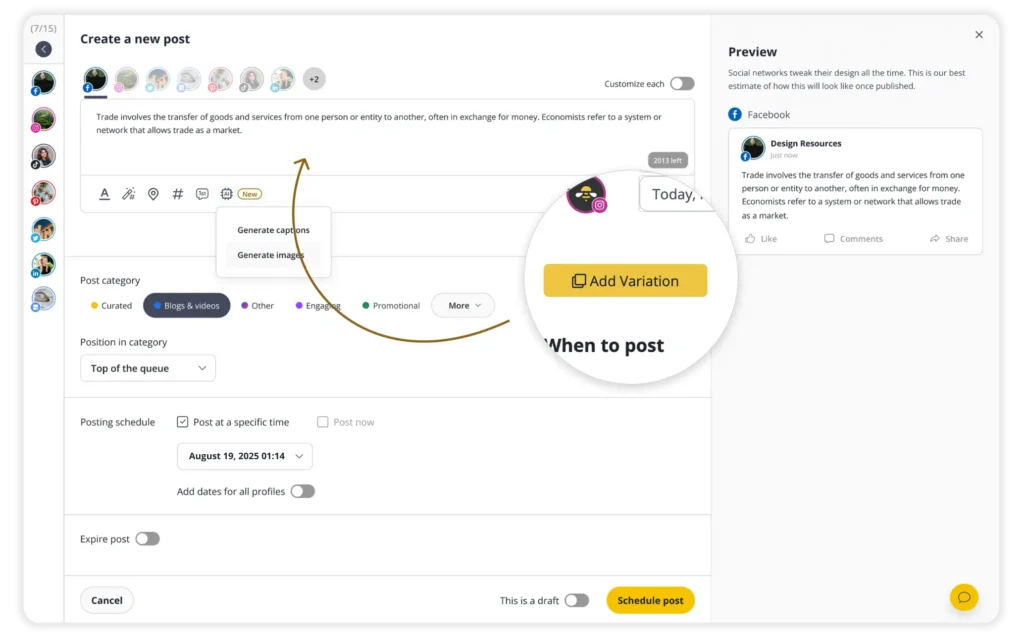
Customizing posts for each platform is much easier when you don’t have to start from scratch every time. With SocialBee, you can create multiple variations of the same post from a single content editor and adjust each one to fit the platform. You can change the word count, upload different media for each variation, add platform-specific hashtags, and fine-tune the copy as needed.
SocialBee’s AI can also help adapt your posts automatically, so your Instagram and TikTok content feels native without doubling your workload. This makes it easier to keep a consistent posting schedule while still respecting how each platform works.
Step 7: Respond to comments and DMs from prospective clients
Social media is all about connecting with prospective clients and guiding them down your sales funnel.
As a lawyer, you surely must recognize the importance of communication and social conversations. Use social media to respond to comments and direct messages (DMs) from your future clients, even on negative posts. There will always be people who will have questions about the legal matters you specialize in.
We’re certain that you already know this, but responding to comments or DMs in a professional manner is mandatory at all times. To make it easier, imagine that you’re talking to each follower as you would if you were face-to-face with them, in your office.
Finally, make sure that the advice you give is always accurate and up to par as far as the current laws, regulations, and standards go. We know that offering high-quality legal representation for your prospective clients is your top priority. Social media is here to enhance that.
If you’re managing comments and DMs across multiple social media platforms, keeping up can get messy fast. Messages come in from different social media accounts, context gets lost, and response times slip.
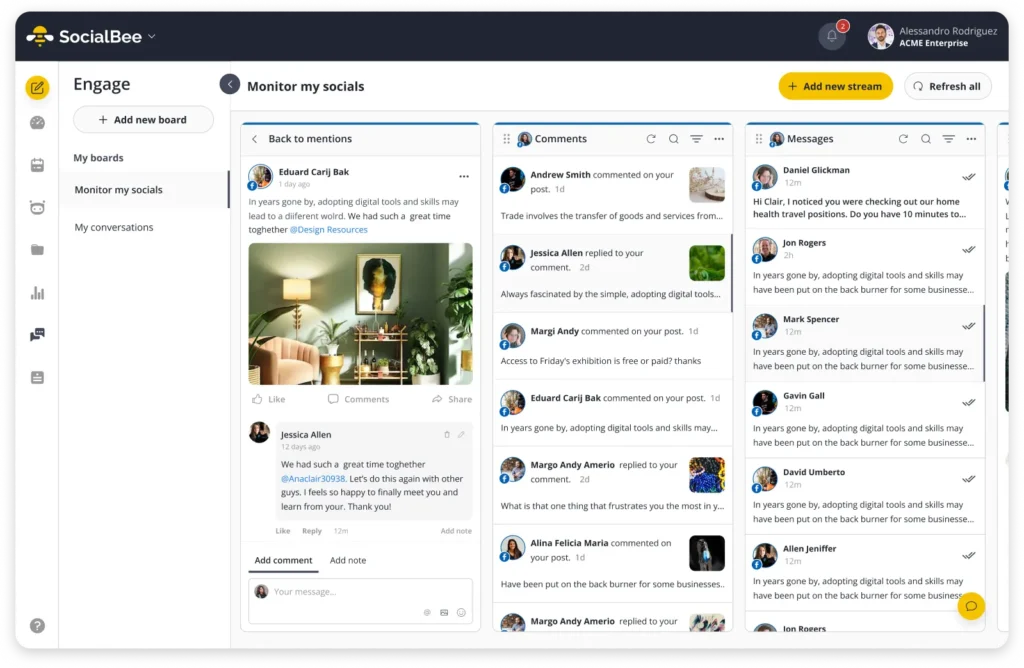
With SocialBee’s unified social inbox, you can view and reply to comments, mentions, and direct messages from all your social media channels in one place. For law firms, it’s a practical way to manage social media communication while staying consistent and reducing the risk of missed messages.
Step 8: Leverage hashtags and keywords
Hashtags and keywords help your social media posts reach the right audience, but for lawyers, restraint matters. Overusing generic or promotional tags can look spammy and undermine trust, especially in a regulated industry like legal marketing.
Hashtags work best when they help your content join relevant conversations on social media platforms. Instead of chasing reach, use them to signal context. Legal topics, practice areas, locations, and real-world scenarios tend to perform better than broad, high-volume tags.
A few practical guidelines that tend to work well for law firms:
- Avoid keyword stuffing with tags like #LawyerNearMe or repeating the same hashtags on every post. This often looks promotional and adds little value.
- Prioritize combinations of location, practice area, and scenario where it makes sense, such as a city name paired with a legal topic or legal update.
- Use fewer, more relevant hashtags rather than long lists that dilute your message.
- Pay attention to which hashtags attract comments and saves, not just impressions. Engagement quality matters more than raw reach.
Keywords play a slightly different role. They’re most useful in places people actually read closely, such as your bio, business page description, and paid social media advertising. A clear structure works best:
- Practice area
- City or region
- Short, neutral call to action
For example, a bio that clearly states what you do, where you practice, and how to contact you is more effective than a list of generic keywords.
Examples of commonly used legal hashtags and keywords
Hashtags
- #LawFirm
- #LegalServices
- #LegalUpdates
- #CriminalDefense
- #ImmigrationLaw
- #CorporateLaw
- #CivilRights
Keywords
- Lawyer
- Immigration lawyer
- Divorce lawyer
- Car accident lawyer
- Bankruptcy attorney
- Business attorney
- Criminal defense attorney
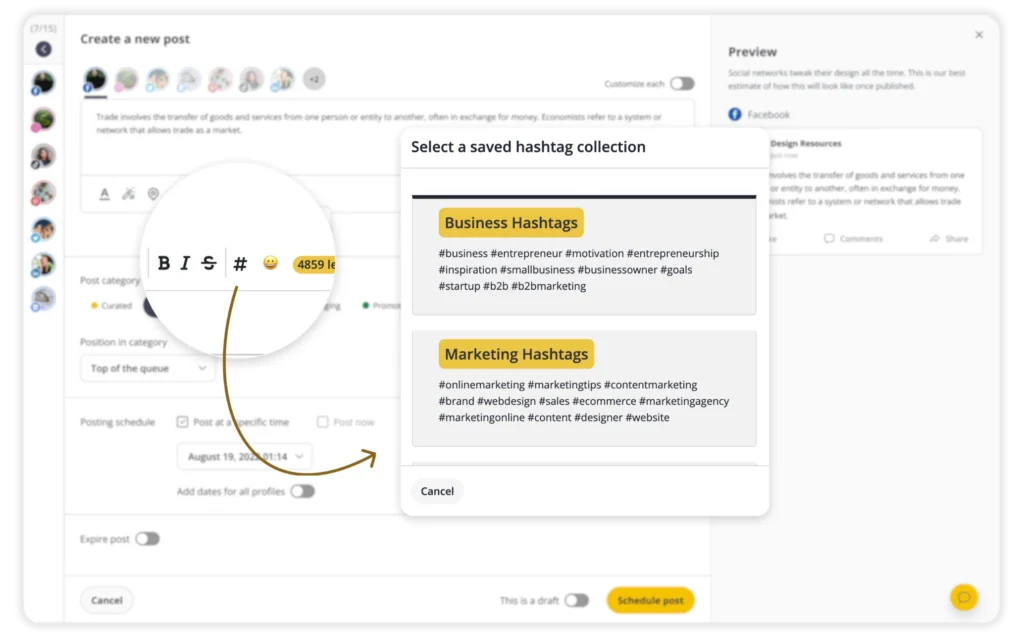
If you’re managing multiple social media accounts, organizing hashtags manually can become time-consuming. With SocialBee, you can create hashtag collections by topic or practice area and reuse them when scheduling posts, which helps keep your social media efforts consistent without overloading each post.
Step 9: Set clear content pillars you can repeat without burning out
Content pillars turn social media from an ongoing decision-making problem into a repeatable system.
Most lawyers don’t stop posting because social media “doesn’t work.” They stop because it constantly demands decisions. What should I post? Is this appropriate? Have I already said this? Is this even helping?
Content pillars remove that friction. Each pillar represents a type of content that serves a specific purpose, so every post fits into a larger strategy instead of standing alone.
Strong content pillars for lawyers typically include:
- Educational clarity: Explain complex legal concepts in plain language so people understand their situation better without receiving legal advice.
- Misconceptions and risks: Address common assumptions that cause people to delay or make costly mistakes.
- Process transparency: Show what working with your firm looks like, which reduces anxiety before the first call.
- Scenario-based context: Describe anonymized situations (making sure to respect your ethical obligations) that help people recognize themselves in the problem.
- Professional judgment: Share how you think through cases, not what someone should do.
Because each pillar serves a different purpose, your content naturally stays varied. You’re not repeating the same message, and you’re not scrambling for ideas every week. You rotate between perspectives, not topics.
This structure also makes consistency realistic. Even during busy periods, you know exactly what type of content you’re creating and why. Over time, that consistency builds familiarity, trust, and recognition, long before someone needs to hire a lawyer.
Once you have content pillars in place, the real test is whether you can stay organized and efficient when planning your content creation week after week.
SocialBee helps you organize posts by topic in different folders, schedule them in advance, and keep a healthy mix of educational, trust-building, and visibility content without having to think about it every day.
Instead of asking yourself what to post between meetings or hearings, you set the structure once and let it support your practice quietly in the background.
Step 10: Monitor your social media presence
A strong social media presence doesn’t come from posting alone. It comes from paying attention to what your social media efforts actually produce. For law firms, visibility without follow-through rarely leads to new clients.
Monitoring your social media metrics means two things: listening and measuring. You need to notice how people talk about your firm online and understand which posts, ads, or campaigns move prospective clients closer to a consultation. When something underperforms, the goal isn’t to post more, but to adjust what you’re posting and where.
Here are the key social media analytics every lawyer should understand and monitor.
- Follower growth: Shows how many social media users choose to follow or unfollow your accounts over time. This helps you spot whether your content is attracting the right audience, not just a larger one.
- Engagement rate: Measures how people interact with your content through likes, comments, shares, and saves. Higher community engagement usually signals relevance and trust, which matter more than raw reach.
- Reach: Indicates how many unique users saw your content. This helps you understand how far your posts travel beyond your existing followers.
- Impressions: Counts how many times your content was displayed, including repeat views. This is useful for understanding visibility, but should always be read alongside engagement.
- Click-through rate (CTR): Shows how many people clicked a link in your post or ad. For law firm marketing, this often signals interest in learning more about your legal services.
- Lead-to-consult conversion rate: The most important metric for most firms. This tracks how many social media leads actually turn into consultation requests. You can measure this using UTM links, call tracking, or a simple intake question like “How did you hear about us?”
- Conversion rate: Measures how often users complete a desired action, such as submitting a contact form or booking a consultation, after interacting with your social media content or ads.
- Brand sentiment: Reflects how people talk about your firm online. Mentions, comments, and discussions can signal trust, confusion, or dissatisfaction that numbers alone won’t show.
Data only becomes useful when it informs decisions. With SocialBee’s analytics and reporting tools, you can see which posts drive engagement, clicks, and inquiries, then adjust your content mix, posting times, and messaging based on what actually moves potential clients toward a consultation.
3 law firms with a great social media marketing strategy
Social media marketing strategy example #1: Ayesha Chidolue, Chidolue Law Firm
Who
Ayesha Chidolue is an immigration lawyer at Chidolue Law Firm who uses social media to educate, build trust, and attract prospective clients.
Platforms used
- TikTok
- YouTube (short-form video only)
What she does
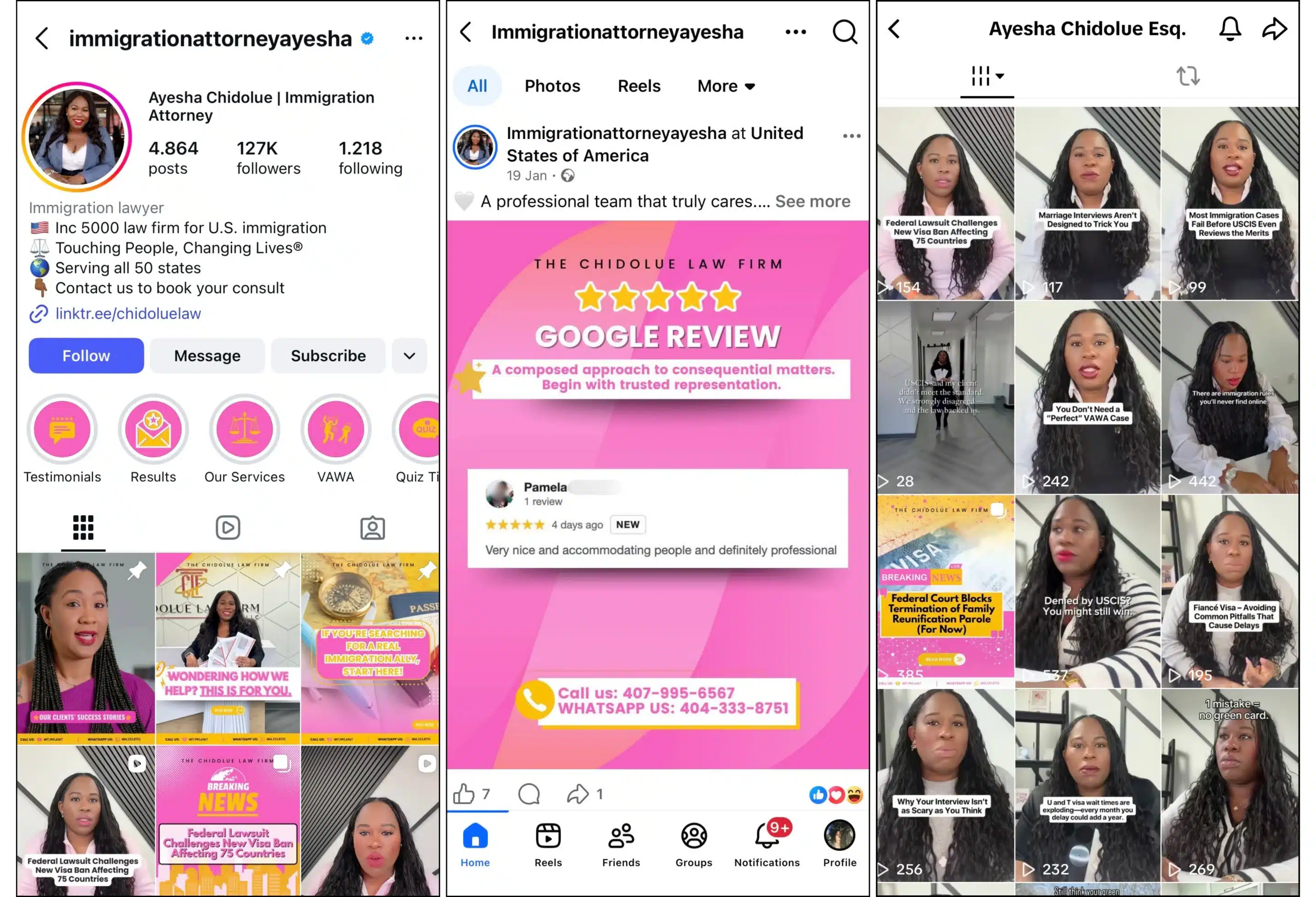
On TikTok, Ayesha focuses on short, educational videos that explain legal topics relevant to immigration law. Her content covers updates on new laws, common visa application mistakes, interview preparation tips, and frequently asked questions. The videos are direct, practical, and avoid legal jargon, making complex legal processes easier to understand.
With her Facebook and Instagram marketing efforts, in addition to educational posts, she shares client reviews and success stories. These posts reinforce credibility and provide social proof without disclosing sensitive details. The tone stays professional, and the focus remains on outcomes rather than guarantees.
YouTube is used as a supporting channel. Instead of long-form content, Ayesha reposts short videos similar to her TikTok, Instagram, and Facebook Reels. This helps extend the reach of existing video content without increasing production effort.
Why it works
- Educational content builds trust before a consultation ever happens
- Platform-specific content matches audience expectations
- Short videos reduce friction for complex immigration topics
- Client reviews add credibility without crossing ethics lines
- Reusing video content across platforms supports consistency
What other law firms can copy
- Use short-form video to explain one legal topic or question at a time
- Share client success stories carefully, focusing on process and experience
- Repurpose the same educational video across TikTok, Reels, and YouTube Shorts
- Keep language simple and informative rather than promotional
Social media marketing strategy example #2: HHP Law Firm (Indonesia)
Who
HHP Law Firm is an international law firm based in Indonesia with a strong focus on brand visibility and professional credibility.
Platforms used
What they do
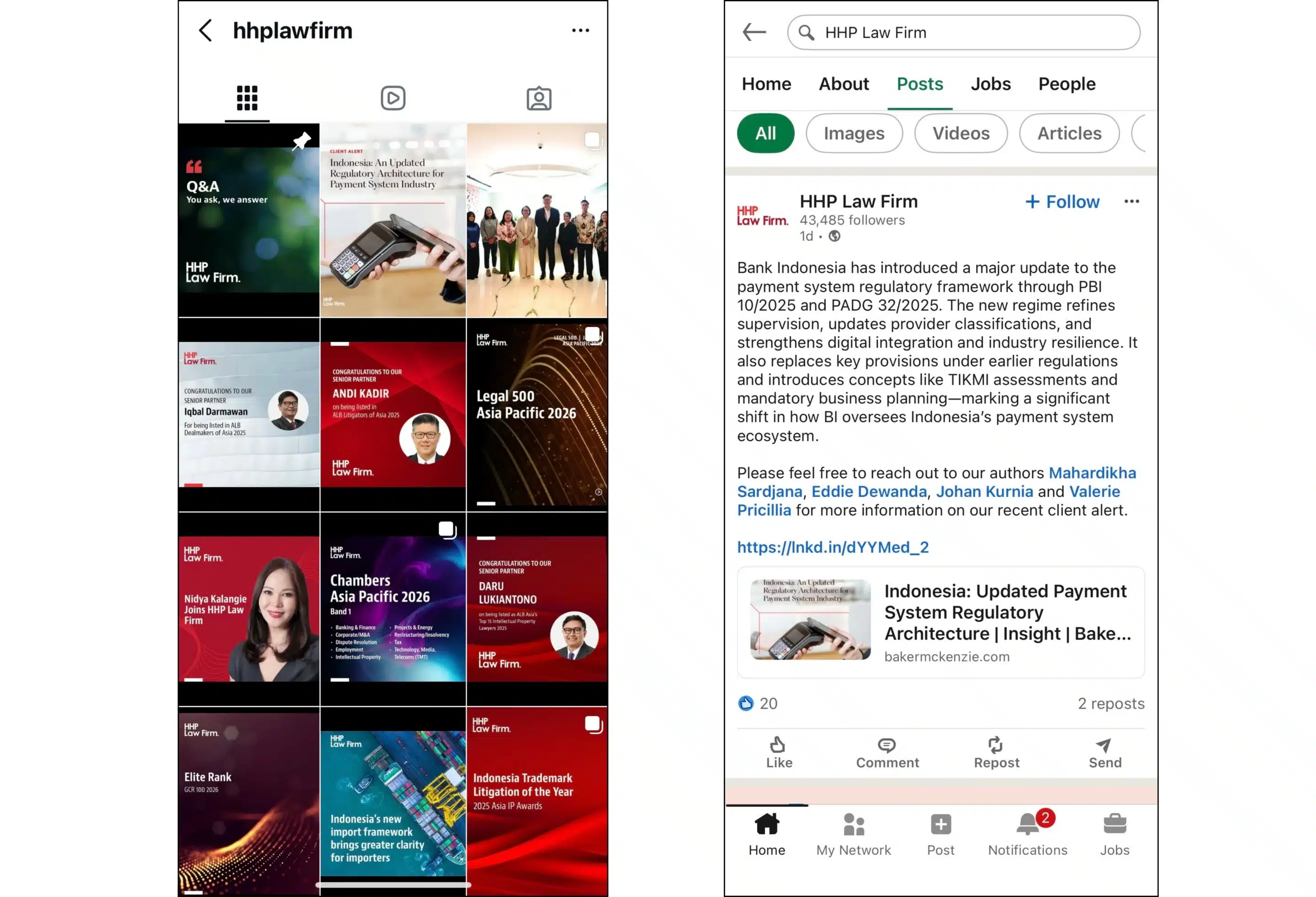
On Instagram, HHP Law Firm shares a mix of internal news and legal updates. They keep a serious image, using their law firm logo as their profile picture to make them recognizable. Their content highlights firm events, awards, and milestones, alongside timely commentary on developments relevant to their practice areas and the legal profession. This gives followers a clear sense of both the firm’s expertise and its internal culture.
They also use interactive formats. A pinned Q&A post invites people to ask questions about working with the firm, which lowers the barrier to engagement without turning the feed into a lead capture channel.
The approach to their LinkedIn presence is similar but adapted to a more professional audience. In addition to firm updates and legal commentary, HHP shares curated links to industry news and external resources. This positions the firm as a reliable source of valuable insights, not just self-promotional content.
Why it works
- Internal updates humanize the firm and reinforce culture
- Legal trends demonstrate expertise without direct solicitation
- Pinned Q&A posts encourage engagement in a low-risk way
- Curated content adds value beyond the firm’s own announcements
- Platform-specific formatting respects audience expectations
What other law firms can copy
- Share internal milestones and awards to reinforce credibility
- Use pinned posts to invite safe, general questions
- Adapt the same core message differently for Instagram and LinkedIn
- Curate and comment on relevant industry news instead of only promoting your own content
Social media marketing strategy example #3: Davana Law Firm
Who
Davana Law Firm is a personal injury law firm that uses social media to balance education, credibility, and approachability.
Platforms used
- TikTok
What they do
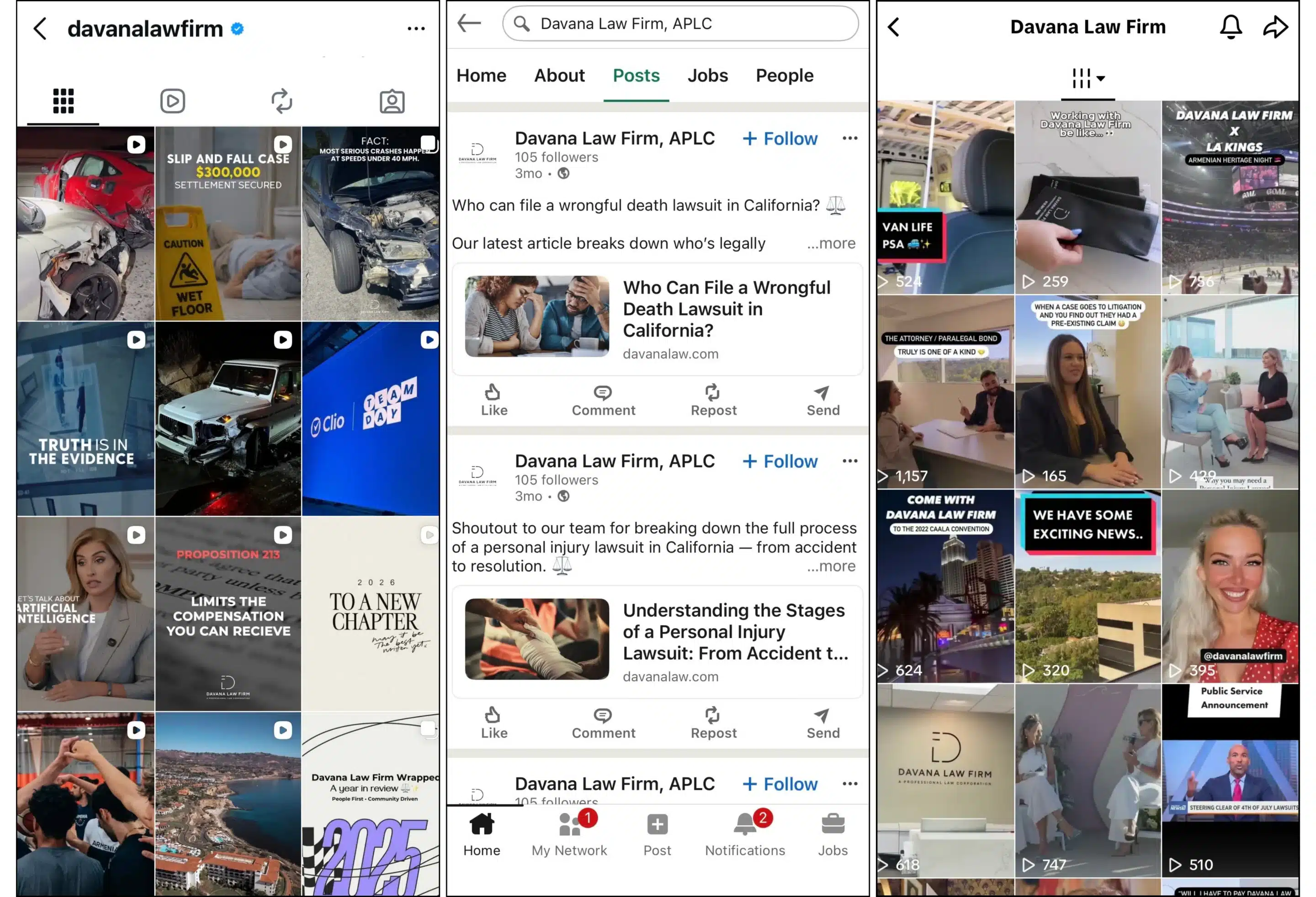
On Instagram, Davana Law Firm shares educational content related to personal injury cases alongside success stories, legal conference highlights, magazine features, and sponsor spotlights. This mix reinforces expertise while also showcasing the firm’s visibility and community involvement.
Their law firm’s Facebook page mirrors much of the Instagram strategy but adapts content formats. The firm uses static posts, carousels, and Reels on their Facebook business page to reach different types of social media users and keep posting varied content without changing the core message.
The firm is leveraging LinkedIn to share blog posts, highlight collaborations, and focus on industry updates that support its law firm marketing and professional relationships while adding their own commentary.
TikTok takes a different tone. The content puts a lighter spin on the personal brand and mixes in humorous posts, often showing behind-the-scenes moments, such as the bond between attorneys and paralegals. This humanizes the firm and makes the brand feel more approachable without undermining the professionalism from other accounts.
Why it works
- Educational posts establish authority in personal injury law
- Success stories and media features build social proof
- Sponsor spotlights and event content support community involvement
- Platform-specific tone keeps content relevant and engaging
- Behind-the-scenes videos strengthen trust and relatability
What other law firms can copy
- Mix educational content with proof points like media features and events
- Reuse the same themes across platforms while changing formats
- Keep LinkedIn focused on professional updates and partnerships
- Use TikTok for controlled, behind-the-scenes content that shows firm culture
Content ideas for a law firm’s social media
1. Share educational content that’s easy to understand
Explain common legal concepts, processes, or timelines in simple terms. Focus on what people need to understand before they ever contact a lawyer. Use short posts, carousels, or brief videos. Keep examples general and avoid advice. Clear, practical explanations build trust and reduce confusion.

2. Share updates on laws and regulations
Highlight legal updates, policy changes, or court decisions that affect your target audience. Focus on what changed and why it matters, without predicting outcomes or offering guidance. Timely updates help position your firm as informed and reliable.

3. Highlight client experiences and success stories
Share client testimonials, reviews, or anonymized success stories that focus on the experience of working with your firm. Emphasize communication, professionalism, and process rather than results. This builds social proof without crossing ethical lines.

4. Share interactive content
Encourage engagement through polls, Q&A posts, or short live sessions focused on general legal topics. Use these interactions to surface common questions and redirect case-specific inquiries to consultations.

5. Show the people behind the firm
Post behind-the-scenes content, team introductions, or moments from events and community involvement. This helps humanize your firm, reinforce firm culture, and make your digital presence feel approachable and professional.

Frequently asked questions
1. How can social media help lawyers build their practice?
Social media helps lawyers build their practice by increasing visibility, keeping their firm top of mind, and allowing them to share educational content that builds trust with potential clients, while also supporting professional networking and community presence.
2. What are some common social media mistakes lawyers make?
Common social media mistakes lawyers make include posting inconsistently, leaving profiles incomplete or outdated, using overly promotional or aggressive language, responding poorly to negative comments, and sharing content that lacks clear value or professionalism.
3. How can lawyers use social media ethically?
Lawyers can use social media ethically by protecting client confidentiality, avoiding individualized legal advice, being truthful in attorney advertising, respecting solicitation rules, maintaining professionalism in public interactions, and sharing general legal information rather than case-specific guidance, while understanding that online content is public and permanent.
Improve your social media marketing efforts
Improving your social media marketing efforts as a lawyer means making clearer decisions and sticking to them. Choose the social media platforms that actually fit your practice, decide what types of content you’ll post, set a cadence you can realistically maintain, and be clear about how comments and messages should be handled. From there, track which posts and campaigns lead to real consultation requests so you know what’s worth repeating.
If something feels hard to maintain, simplify it. In my experience, inconsistent posting usually isn’t a motivation problem, it’s a complexity problem. Short, clear posts published regularly will do more for social media success than an ambitious marketing plan that never gets executed.
Managing social media accounts alongside client work is still a challenge for most lawyers. If staying consistent is proving difficult, SocialBee is a social media management tool for lawyers that helps you batch content, schedule posts, and manage comments and messages from one place.
Start your 14-day free trial and see how much easier it is to keep your social media process active without adding more to your day.