
3 bank workers in an office

Social media for banks: Build trust and drive customer loyalty

Picture of Written by Irina Maltseva
Written by Irina Maltseva

Guest Author

Social media for banks has become an important part of how customers interact with, evaluate, and stay connected to financial institutions. People expect to find timely updates, financial education, security alerts, and responsive customer support on the same social platforms they use to communicate with every other business in their lives.

That expectation creates both an opportunity and a challenge. A thoughtful social media marketing strategy can help banks answer common questions, educate customers, highlight their role in local communities, and strengthen relationships over time. At the same time, every post has to meet regulatory standards, protect customer information, and reflect the trust customers place in the bank.

This guide explains how to build a social media strategy that supports your marketing goals while protecting your brand, your customers, and your reputation. You’ll learn what to post, which social media platforms deserve your attention, and how to create content that earns social engagement without creating unnecessary compliance risks.

SocialBee logo featuring a stylized yellow bee icon on a dark hexagonal background.
SocialBee – Social media management tool
Social media management tool
Get your free social media calendar template!

We’re SocialBee LABS SRL, part of WebPros. We use the information you provide to share relevant content & updates, as outlined in our Privacy Policy. You can opt out anytime.

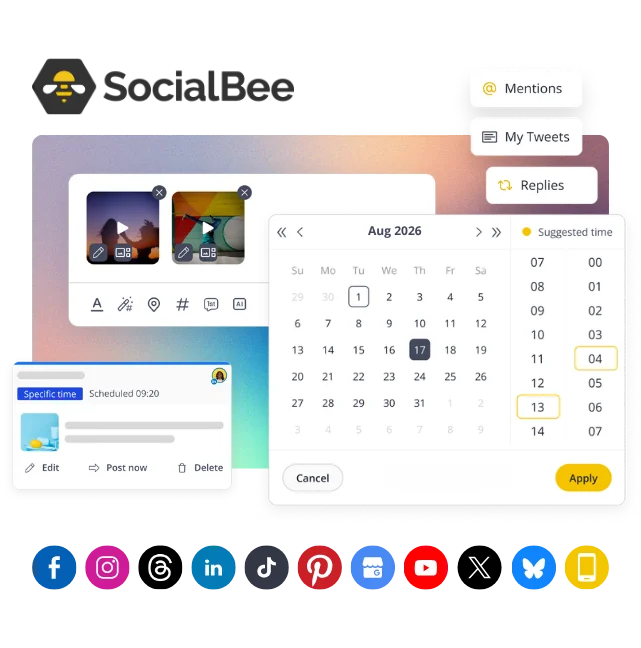
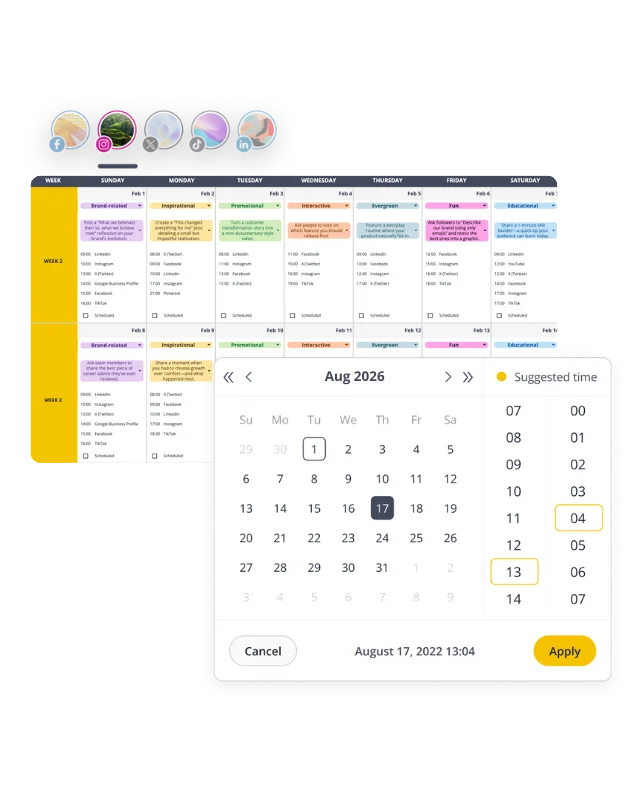
Social media content calendar for February 2026 with category-labeled posts and a scheduling popup showing suggested posting times.

Short summary

  • Banks and other financial institutions can use their social media efforts to build trust, educate customers, provide timely support, and strengthen relationships with their communities.
  • A successful strategy starts with a clear social media policy that defines approval workflows, customer service guidelines, security practices, and team responsibilities.
  • The most effective bank content mixes financial education, fraud prevention, product tutorials, community updates, and promotional posts instead of focusing only on products.
  • Banks should respond quickly while protecting customer privacy, share regular scam awareness content, monitor conversations for emerging issues, and communicate transparently during service disruptions.
  • SocialBee helps banks stay organized by managing content calendars, approval workflows, multiple social media accounts, run a social media audit, and collaboration from one platform.

Why banks need a social media strategy

Social media has become one of the first places people turn to when they want to learn about a business, ask a question, or check whether a company is trustworthy. Banks are no exception. Customers use social media to look for service updates, fraud alerts, financial education, and information about products before they visit a branch or website.

89% of banks say social media is important to their organization, and 88% are actively managing their social media presence.

That doesn’t mean every bank needs to have their social media manager be active on every platform. The goal is to maintain a presence where your audience already spends time and expects to find you. A few well-managed social media accounts are far more valuable than several that are rarely updated or monitored.

An effective content strategy should support several business goals at once:

  • Help customers understand financial products and services through educational content.
  • Share security updates, fraud warnings, and service announcements.
  • Answer general questions like “how to lock your credit” while directing account-specific conversations to secure channels.
  • Introduce new products and promotions without overwhelming followers with sales messages.
  • Showcase community involvement, company culture, and career opportunities.
  • Monitor conversations through social listening to identify complaints, customer sentiment, and impersonation attempts before they become larger issues.

Each of these activities strengthens your brand in a different way. Accurate updates show customers they can rely on your information. Clear financial education makes complex topics easier to understand. Well-defined response processes demonstrate that customer privacy comes first, even when conversations begin on social media.

Which social media platforms should banks use?

You don’t need to build a presence on every social media platform. The best social media strategy starts with the channels your customers already use and the resources your team has to manage them well. For most financial institutions, two or three well-managed accounts will deliver better results than trying to publish everywhere.

When deciding where to invest your time, consider:

  • Where your customers already spend time online.
  • Which platforms generate the most customer questions and support requests.
  • How much time your team can dedicate to creating content and responding to comments.
  • Your compliance guidelines review and approval process.
  • Whether your team can monitor comments, impersonation attempts, and other security risks.
  • The types of content your bank can consistently create.

Here’s how the major platforms compare:

Platform

Best use

Primary audience

Strong formats

Main consideration

LinkedIn

Thought leadership, commercial banking, recruiting

Professionals, business owners, employees

Articles, executive videos, industry trends

Review financial claims and market commentary carefully.

Facebook

Community engagement, customer education, local updates

Existing customers and local communities

Videos, photos, events, community posts

Public complaints require timely moderation and secure follow-up.

Instagram

Brand awareness, financial education, community stories

Consumer audiences, especially younger adults

Reels, Stories, carousels

Keep educational content accurate without oversimplifying financial topics.

YouTube

Long-form financial education and product explainers

Consumers researching financial topics

Tutorials, webinars, product walkthroughs

Review videos regularly to ensure products, rates, and policies remain current.

TikTok

Short educational content and financial tips

Younger adult audiences

Short videos, recurring series, Q&As

Trends move quickly, but compliance requirements don’t. Every post still needs review.

X

Service updates, fraud alerts, media communication

Customers, journalists, public agencies

Short updates, replies, announcements

Expect real-time conversations and monitor for impersonation and customer complaints.

Reddit

Industry discussions and community engagement

Topic-based communities

AMAs, educational discussions

Conversations can’t be controlled, so focus on providing expertise rather than promotion.

Threads

Brand conversations and community interaction

Consumer audiences

Short posts, replies, behind-the-scenes content

Discussions move quickly, making active moderation important.

Choose each platform based on the job you want it to do. Facebook works well for community updates and customer communication, LinkedIn helps build credibility with business clients and potential employees, while YouTube gives you the space to explain complex financial topics that don’t fit into a short post. Matching the platform to the content leads to better social media engagement and makes your social media marketing easier to manage.

11 best social media tips for banks

Social media gives banks the opportunity to answer customer questions, educate people about fraud, build trust through transparent communication, and strengthen relationships with the communities they serve.

Social media success for banks means balancing helpful content with strong internal processes. That means creating content people actually want to see while making sure every post is accurate, secure, and compliant.

Here are 11 tips to help your bank build a stronger, more trusted social media presence:

  1. Create a social media policy.
  2. Respond to customers quickly and securely.
  3. Help customers stay safe online.
  4. Create a balanced content mix.
  5. Be transparent with your customers.
  6. Stay organized with a social media management tool.
  7. Use video to explain complex topics.
  8. Encourage community engagement.
  9. Work with trusted experts.
  10. Listen to your audience.
  11. Measure what really matters.

1. Create a social media policy

Before you start planning content, make sure your team has clear guidelines for managing your bank’s social media presence.

Unlike most businesses, banks have to balance marketing, customer support, compliance, and security. A social media policy helps everyone understand their responsibilities, reduces the risk of mistakes, and keeps communication consistent across every platform.

Your policy should answer questions like:

  • Which social media accounts are officially managed by the bank?
  • Who owns each account and who has publishing access?
  • Which posts require legal or compliance approval?
  • How should employees respond to customer questions?
  • What information should never be shared publicly?
  • What disclosures are required for promotional content?
  • How are influencer partnerships reviewed and approved?
  • When should scheduled posts be paused, such as during a service outage or security incident?
  • How long should social media content and customer interactions be retained?
  • Who is responsible for correcting or removing inaccurate posts?

The clearer these processes are, the easier it becomes to publish confidently without creating unnecessary bottlenecks.

PRO TIP

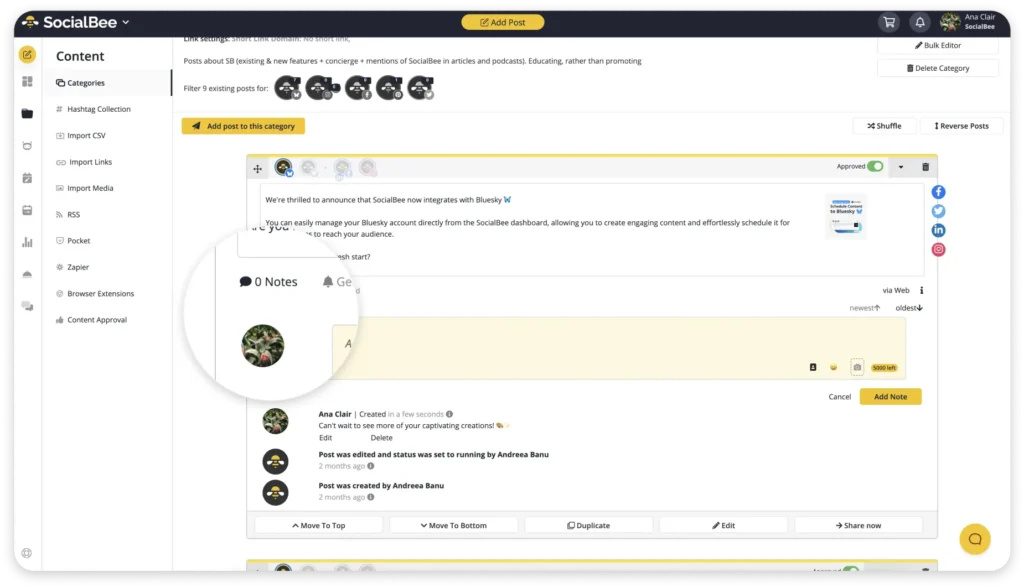
If multiple teams contribute to your social media, SocialBee can help simplify the approval process. You can assign roles, leave internal notes, send posts for approval before publishing, and organize different brands or business units into separate workspaces. Your team stays aligned without relying on long email chains or spreadsheets.

2. Respond to customers quickly and securely

Many customers turn to social media first when they have a question, notice suspicious activity, or can’t access their account. While it’s a great place to start the conversation, it shouldn’t become your bank’s customer support desk.

The goal is to respond quickly while protecting customer privacy.
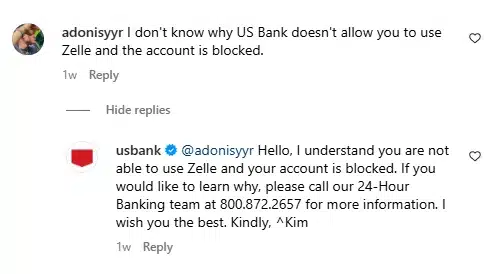
A customer comment on Instagram questioning a Zelle block is met with a polite and informative response from US Bank's social team, directing the user to a support line for more details.

A simple response process looks like this:

  • Acknowledge the customer’s question or concern.
  • Never ask for account numbers, card numbers, passwords, PINs, one-time verification codes, or other sensitive information publicly.
  • Move account-specific conversations to a secure support channel.
  • Escalate fraud reports or security concerns to the appropriate team.

It’s also worth reminding customers regularly that your bank will never ask them to share passwords, security codes, or full account details through social media. Repeating that message can help people spot impersonation scams before they become victims.

If you use AI chatbots, keep them focused on answering general questions like branch hours or available services. Product recommendations, account-specific issues, and financial guidance should always be handled by a person or verified through official resources.

Knowledge base software can also help your team deliver more consistent support. When customer service representatives have access to approved answers, policies, and procedures, they’re less likely to give conflicting information and can resolve common questions more efficiently across every channel.

Customers appreciate fast replies, but they’ll value secure, accurate support even more.

3. Help customers stay safe online

One of the most valuable things a bank can share on social media isn’t a new product. It’s information that helps customers avoid becoming the next fraud victim.

Scammers are constantly changing their tactics, so financial education shouldn’t be a one-time campaign. Make it a regular part of your content and sales strategy by sharing practical advice customers can actually use.

An older woman and a younger woman smile while looking at a smartphone together, with overlay text saying “Help stay protected.” The tweet warns about scammers posing as trusted contacts.

Focus on common threats like:

  • Cyber threats like phishing emails and text messages
  • Fake customer support accounts
  • Investment and cryptocurrency scams
  • Romance and impersonation scams
  • QR code scams
  • Wire transfer fraud
  • Account takeover attempts

A simple format makes these posts easy to understand:

  1. Explain the scam.
  2. Show the warning signs.
  3. Tell customers what they shouldn’t do.
  4. Share the safest next step.
  5. Link to your bank’s official fraud resources.

When a new scam starts circulating, don’t be afraid to pause less important content and publish a timely warning instead. Those posts are often the most valuable content your bank can share.

4. Create a balanced content mix

If every post is promoting a new checking account, secured business credit card, or loan, don’t expect people to stick around.

People follow banks for plenty of reasons beyond your products. They want practical financial advice, updates about their accounts, fraud alerts, and information about what’s happening in their community. The more useful your content is, the more likely people are to keep coming back.

A balanced content mix could include:

  • Financial education: Budgeting tips, credit scores, saving strategies and opening a savings account, mortgages, investing, and small business finance.
  • Fraud and security: Scam alerts, phishing warnings, safe banking habits, and reporting instructions.
  • Product help: Mobile app tutorials, branch services, account features, and answers to frequently asked questions.
  • Community impact: Local partnerships, volunteer work, financial literacy events, grants, and scholarships.
  • Trust and transparency: Service updates, planned maintenance, policy changes, and outage notices.
  • Employer brand: Employee stories, hiring announcements, workplace culture, and career opportunities.
  • Product promotions: New products, rates, special offers, and feature launches, accompanied by the required disclosures.

Not every category needs to appear every week, but your audience should see more than messages designed for the sales process when they visit your profile.
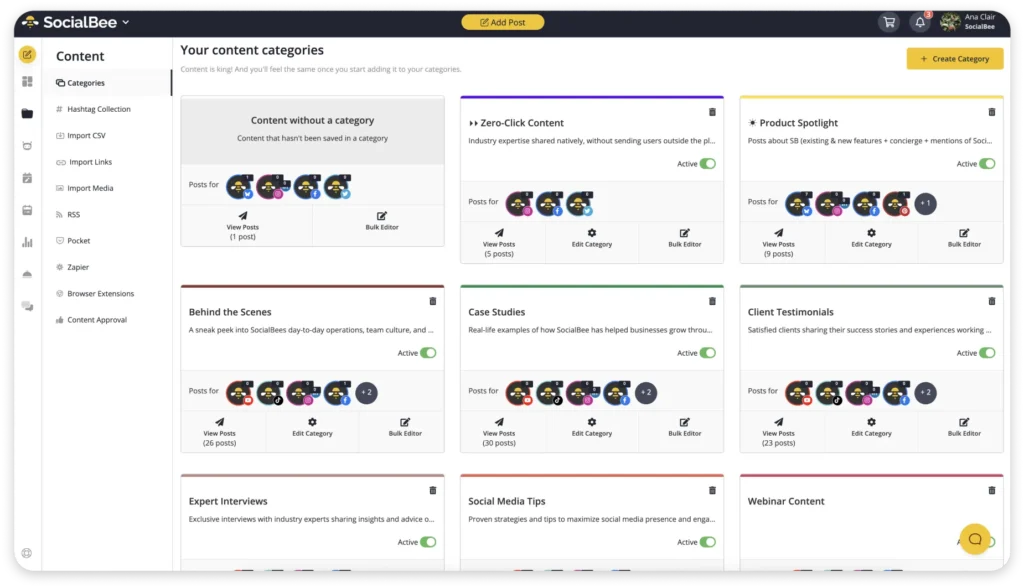
PRO TIP

SocialBee’s content categories make it easy to organize your posts by topic. You can separate financial education, fraud alerts, community news, and product updates into different categories, then build a publishing schedule that keeps your content varied instead of repetitive.

5. Be transparent with your customers

Trust is one of the biggest reasons people choose one bank over another, and social media plays a big role in maintaining that trust and managing customer expectations.

Customers don’t expect your bank to be perfect. They do, however, expect clear communication when something changes.
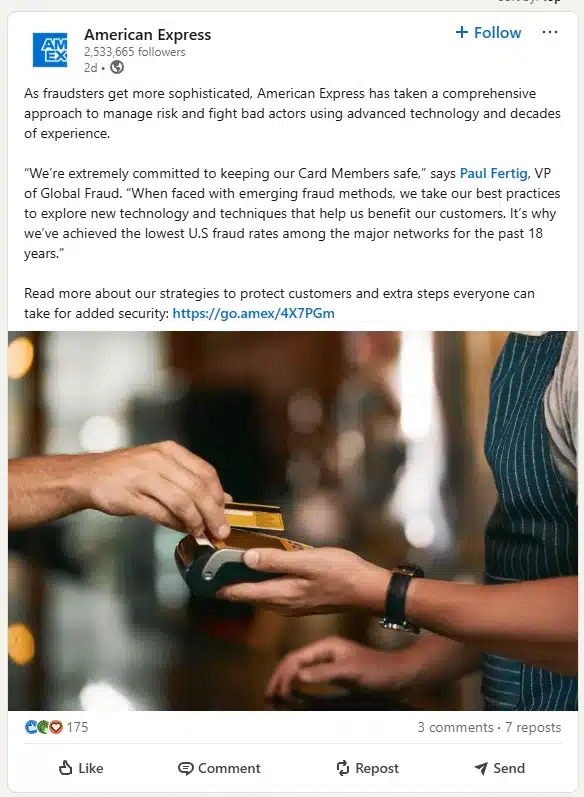
A close-up image of one person handing a credit card to another in a warm-toned environment, accompanying a LinkedIn post from American Express discussing fraud protection strategies.

Whether you’re rolling out a new feature, updating your fees, or dealing with an unexpected service disruption, tell customers what happened, who is affected, and what they should do next. If you don’t have all the answers yet, it’s okay to say that. It’s better to share verified information than speculate.

During incidents, your updates should answer a few basic questions:

  • What happened?
  • Who is affected?
  • What services are still available?
  • What should customers do?
  • Where can they find official updates?
  • When will you share more information?

6. Stay organized with a social media management tool

Managing social media for a bank involves much more than scheduling posts. Marketing, compliance, customer support, and leadership often need to collaborate before content goes live, and that process can quickly become difficult to manage without the right tools.

A social media management tool helps your team stay organized by keeping content, approvals, and publishing schedules in one place.

Look for features like:

  • Shared content calendars.
  • Role-based permissions.
  • Approval workflows.
  • Internal notes and collaboration.
  • Platform-specific post customization.
  • Analytics and performance tracking.

AI can also help speed up brainstorming and drafting, but every post containing financial information, rates, product details, or compliance-sensitive claims should always be reviewed before it’s published.
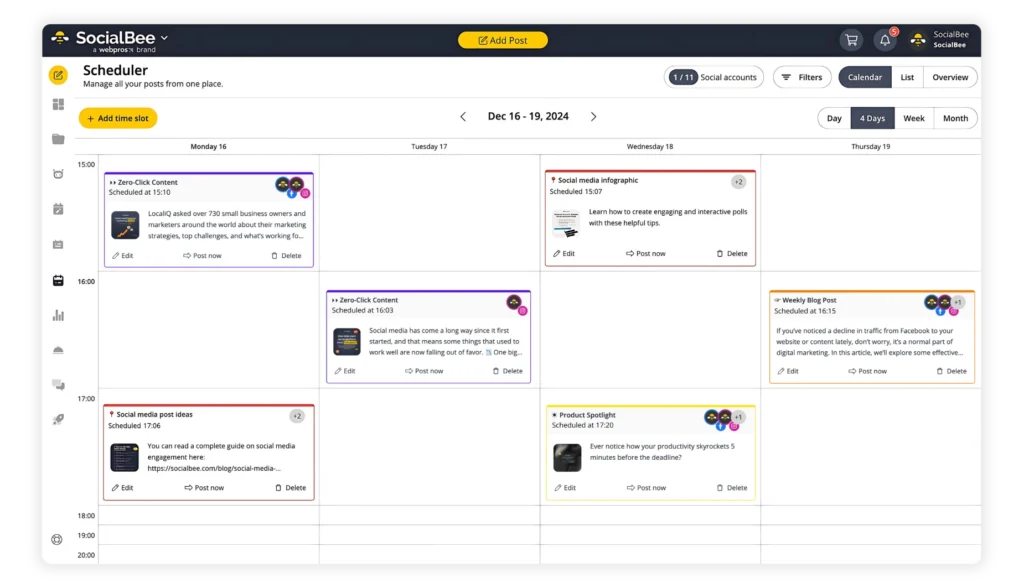
PRO TIP

SocialBee combines content planning, scheduling, approvals, collaboration, and analytics in one platform. Teams can draft posts, request feedback, customize content for each social network, and schedule campaigns with full visibility into what’s being published across every account.

7. Use video to explain complex topics

Some banking tasks are much easier to show than explain.

A short video demonstrating how to freeze a debit card, enable two-factor authentication, or set up account alerts is often more helpful than a long written guide. Video also gives your team a chance to put a face to your brand, making your bank feel more approachable and trustworthy.
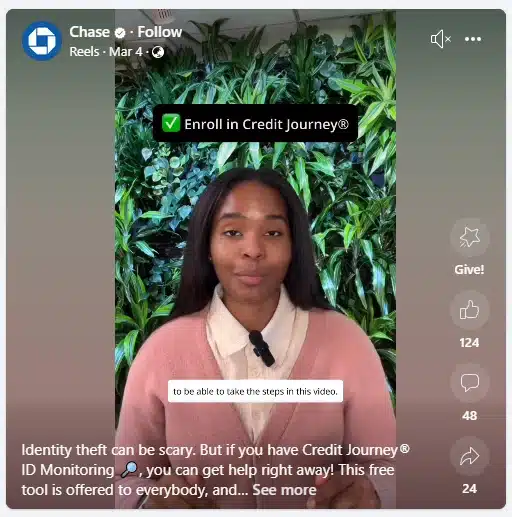
A young woman in a pink sweater and white shirt speaks to the camera with a lush green wall behind her. A green checkmark and “Enroll in Credit Journey®” appear at the top, promoting Chase’s free identity monitoring tool.

Some of the best video content for banks includes:

  • Tutorials for your mobile app and online banking features.
  • Fraud alerts and scam awareness videos.
  • Quick explanations of financial topics like credit scores, mortgages, or budgeting.
  • Frequently asked customer questions.
  • Community events and financial literacy initiatives.
  • Behind-the-scenes content featuring employees and local branches.

Keep each video focused on one topic and one clear takeaway. Customers should be able to watch it in a minute or two and immediately know what to do next.

Before publishing, make sure every video includes captions, accurate product information, required disclosures, and doesn’t display any real customer data or sensitive information.

8. Encourage community engagement

Banks play an important role in the communities they serve, and your social media should reflect that.

Instead of focusing every conversation on your products, create opportunities for people to engage with your bank in more meaningful ways. Highlight local events, celebrate small businesses, support financial literacy initiatives, and invite your audience to join the conversation.

A cheerful woman sits at a table during a community event, surrounded by others, as part of Barclays’ “Make a Difference” campaign supporting local volunteering and charities.

You can encourage engagement by:

  • Sharing photos from community events and volunteer initiatives.
  • Spotlighting local businesses or nonprofit organizations.
  • Asking questions about financial habits or community topics.
  • Running polls to gather feedback on educational content.
  • Celebrating local achievements and partnerships.

If customers leave reviews or positive comments, take the time to thank them. For complaints or account-specific issues, respond professionally and move the conversation to a secure support channel without confirming publicly that someone is a customer. This helps preserve customer loyalty.

ABA EVP Russell Davis said, “When used effectively, social media helps banks humanize their brand and build relationships while offering a strong return on investment.”

9. Work with trusted experts

Partnering with the right people and sharing user-generated content can help your bank reach new audiences and make financial topics easier to understand.

That doesn’t always mean hiring influencers. In many cases, your own employees are your most credible ambassadors. Mortgage advisors, fraud specialists, financial educators, and small business bankers can provide practical advice that customers trust because it comes directly from experienced professionals.

If you do collaborate with creators or banking industry experts, choose partners who genuinely align with your brand and audience. Before publishing any content, review it carefully to make sure financial information is accurate, disclosures are included where required, and any sponsored relationship is clearly identified.

Reese Witherspoon sits in a red outfit against a minimalist background, mid-speech, in a video post by American Express highlighting her talk at Centurion New York about innovation and leadership.

Whether the content comes from an employee or an external creator, the goal should be the same: help your audience learn something useful, not just promote a product.

10. Listen to your audience

Your bank’s social media isn’t just a place to publish content. It’s also one of the easiest ways to understand what customers are thinking.

Some customers might tag you in videos or posts with reviews or opinions, and paying attention to them will bring a lot of information about what your company is getting right and wrong. It’s also a great source for UGC:

A smiling man in a gray vest and purple shirt holds up an American Express Platinum card, with text overlay reading "here's my honest review in 60 seconds."

Beyond replying to tags and monitoring brand mentions, comments, and direct messages, pay attention to the conversations happening around your brand. Are customers asking the same questions repeatedly? Are they confused about a new feature? Is a scam targeting people in your area? Those patterns can help you improve your content, customer support, and even your products.

Review these conversations regularly and share what you learn with the teams that can act on it. Marketing might notice content gaps, customer support may identify common issues like QA bugs, and product teams can uncover opportunities for improvement.

PRO TIP

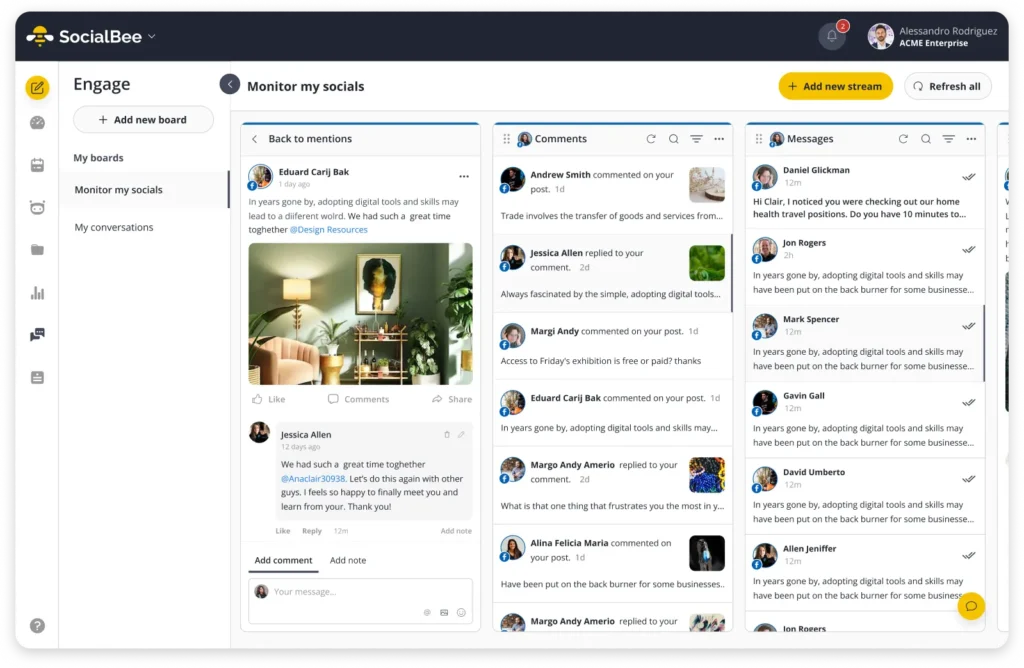
If your team manages several social media accounts, SocialBee’s Social Inbox brings comments, mentions, and messages from multiple platforms into one place. Instead of switching between apps, your team can monitor conversations, reply faster, and make sure important messages don’t get overlooked.

11. Measure your social media performance

If you don’t measure your results, it’s hard to know what’s actually working.

Likes and follower counts can be nice to see, but they don’t tell the whole story. A post that generates thousands of likes isn’t necessarily helping customers, building trust, or supporting your marketing goals.

Instead, focus on the social media metrics that show how your content performs and how your audience responds.

Keep an eye on metrics like:

  • Reach and impressions: How many people are seeing your content?
  • Engagement rate: Which posts generate the most reactions, comments, shares, and saves?
  • Audience growth: Are you attracting new followers over time?
  • Link clicks: Are people visiting your website or learning more about your products?
  • Video performance: Which videos have the highest watch time and completion rate? 

Review your analytics regularly to identify patterns. You might find that short educational videos generate more engagement than static graphics, for example. Those insights help you create more of the content your audience actually values.

PRO TIP

SocialBee’s Analytics dashboard lets you monitor performance across your connected social media accounts from one place. Instead of switching between platforms, you can compare engagement, audience growth, reach, and your top-performing posts to see what’s working and where you can improve.

Frequently asked questions

1. How should banks respond to customer complaints on social media?

Start by acknowledging the customer’s concern without discussing account details publicly. If the issue involves personal information or account-specific support, direct the customer to a secure support channel, such as online banking, a verified phone number, or an in-branch representative. Finally, make sure the interaction is recorded and escalated internally if further action is needed.

2. Can banks provide customer support through social media?

Yes, but only for general questions. Social media is a good place to answer questions about branch hours, available services, or where customers can find help. Issues involving account access, transactions, personal information, or suspected fraud should always be handled through secure, authenticated channels.

3. What social media regulations do banks need to follow?

The rules vary depending on the country, the type of financial institution, and the products being promoted. Banks must comply with applicable advertising, privacy, consumer identity protection, and financial services regulations, while also following platform policies. Marketing, legal, and compliance teams should work together to review content before it’s published.

4. How can banks prevent impersonation scams on social media?

Start by verifying your official social media accounts whenever possible and clearly linking them from your website. Monitor social media for fake profiles using your name or branding, report impersonation accounts promptly, and regularly remind customers that your bank will never ask for passwords, PINs, or one-time verification codes through social media. Public education and quick action to issues like data breach alerts are the best defenses against impersonation scams.

Build a social media presence your customers can rely on

People don’t expect their bank to post viral memes. They do expect clear answers, helpful advice, and timely updates when they need them.

That’s why the best bank social media strategies focus on being useful first. Post content that helps customers make smarter financial decisions, respond thoughtfully when questions come up, and have clear processes in place so your team can communicate confidently, even during unexpected situations.

Managing all of that is much easier when your content is planned ahead of time. SocialBee helps teams organize posts into content categories, collaborate on drafts, manage multiple accounts, and send content through an approval workflow before it goes live. With everything in one content calendar, you can also review, edit, or pause scheduled posts whenever priorities change.

Start your 14-day free SocialBee trial and build a social media strategy that’s organized and ready for whatever comes next.

SocialBee: Your AI-powered social media management tool
Create posts, publish, analyze, engage and collaborate, all from SocialBee.

About the author: Irina Maltseva is a Growth Lead at Aura, a Founder at ONSAAS, and an SEO Advisor. For the last ten years, she has been helping SaaS companies to grow their revenue with inbound marketing.

Summarize this post
SocialBee logo featuring a stylized yellow bee icon on a dark hexagonal background.
SocialBee – Social Media Management Tool
Works with 10+ social media platforms

Related articles

Level up your social media marketing with exclusive resources delivered straight to your inbox

We’re SocialBee LABS SRL, part of WebPros. We use the information you provide to share relevant content and product updates, as outlined in our Privacy Policy. You can opt out anytime.

Something special for you!

Get 20% off your SocialBee plan for 3 months. Just enter your email below and we’ll send you the discount code.

Email us at success@socialbee.com if you need any help.