

Most LinkedIn advice sounds the same.
“Post consistently.” “Write better hooks.” “Engage with your audience.”
None of that is wrong, but it also doesn’t explain why some brands seem to dominate the platform while others barely get noticeåd.
The reality is that LinkedIn has become one of the most important marketing channels for businesses. Today, 72% of marketers worldwide include LinkedIn in their marketing strategy, while 51% of B2B marketers consider it their most important social media platform. If your audience includes decision-makers, buyers, recruiters, or industry professionals, there’s a good chance they’re already spending time there.
If you look at the companies consistently winning on LinkedIn in 2026, you’ll notice they aren’t relying on viral posts or algorithm tricks. They’re following a clear content strategy. They know exactly who they’re talking to, what they want to be known for, and how every post supports a bigger business goal.
In this guide, I’ll break down the LinkedIn content strategy I see top brands using today, along with practical examples and the process I use to build a content plan that actually creates conversations, attracts the right audience, and supports long-term growth.

What makes LinkedIn an important social media platform for your brand
LinkedIn has become much more than a place to upload your CV.
Today, it’s where people discover new companies, follow industry experts, research potential partners, and often decide whether a business is worth paying attention to. Before booking a demo or reaching out, many buyers will check your LinkedIn presence to see what your company is talking about and whether you have something valuable to say.
That’s why LinkedIn has become such an important channel for brands:
- You can reach the right people
- It helps people trust your brand
- Your content keeps working after you publish it
- It’s not just about getting customers
- People want to hear from people
1. You can reach the right people
Unlike many other social media platforms, LinkedIn is built around professional connections. Your content has the chance to reach founders, executives, marketers, recruiters, buyers, and other decision-makers without needing a huge advertising budget.
2. It helps people trust your brand
People rarely buy from a company they’ve just discovered.
By regularly sharing useful insights, customer stories, lessons learned, or your perspective on what’s happening in your industry, you give people a reason to remember you. Over time, that familiarity turns into trust.
3. Your content keeps working after you publish it
A good LinkedIn post doesn’t disappear after a few hours. It can continue generating comments, shares, profile visits, and website traffic for days or even weeks as people keep engaging with it. In fact, the average LinkedIn post received 1.74 engagements in 2025, up from 1.57 the year before, showing that engagement on the platform continues to grow.
And it’s not just posts. LinkedIn articles can also rank in search engine results, helping you reach people actively looking for information on your topic. A recent study found that AI search engines frequently cite LinkedIn content, making it one of the most visible platforms in AI-powered search results. Every piece of content becomes another opportunity for someone to discover your business.
4. It’s not just about getting customers
A strong LinkedIn presence can help with much more than lead generation.
Many companies use LinkedIn to:
- Attract new talent
- Build their employer brand
- Announce product launches
- Strengthen customer relationships
- Grow their founders’ personal brands
- Create new partnerships
One content strategy can support several business goals at once.
5. People want to hear from people
One of the biggest shifts on LinkedIn over the last few years is that polished corporate messaging doesn’t perform as well as it used to. People engage with stories, opinions, lessons learned, and content that feels like it was written by an actual person.
The brands doing well on LinkedIn understand this. Instead of treating the platform like another advertising channel, they use it to start conversations and share what they’re learning.
Top brands killing it on LinkedIn in 2026
If you want to improve your LinkedIn strategy, don’t start by looking at brands with millions of followers. Start by looking at brands that consistently publish content people actually engage with.
The companies below have built recognizable voices on LinkedIn. Their posts don’t all look the same, but they follow a similar approach. They know their audience, they stick to a few key topics, and they rarely make every post about their product.
You don’t need to copy what they’re doing. Instead, look at why their content works and think about how you can apply the same principles to your own brand.
Let’s look at five brands that are doing LinkedIn particularly well in 2026 and what you can learn from each of them:
- Wiz
- Tl;dv
- Ramp
- Ahrefs
- Deel
1. Wiz
Wiz is one of the best examples of how a highly technical company can still have a fun, recognizable presence on LinkedIn.
The company specializes in cloud and AI security, but instead of filling its feed with product updates and technical jargon, it turns complex topics into content people actually want to read.
When the team discovers a new security vulnerability, they explain what happened, why it matters, and what people can learn from it. Even if you’re not a cybersecurity expert, you can still follow the story.
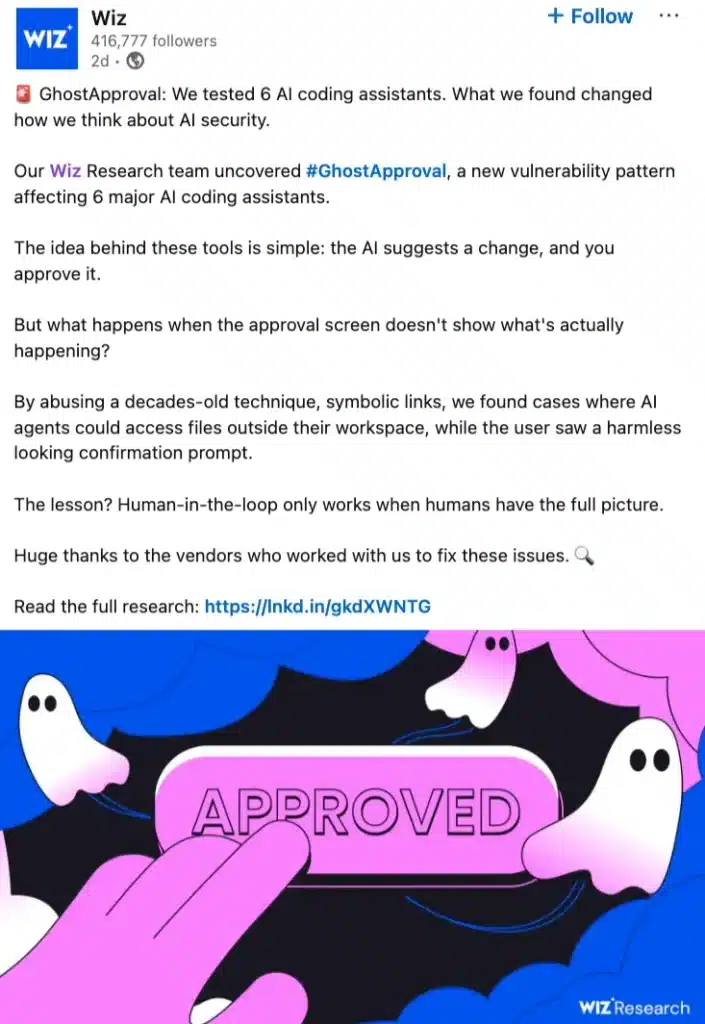
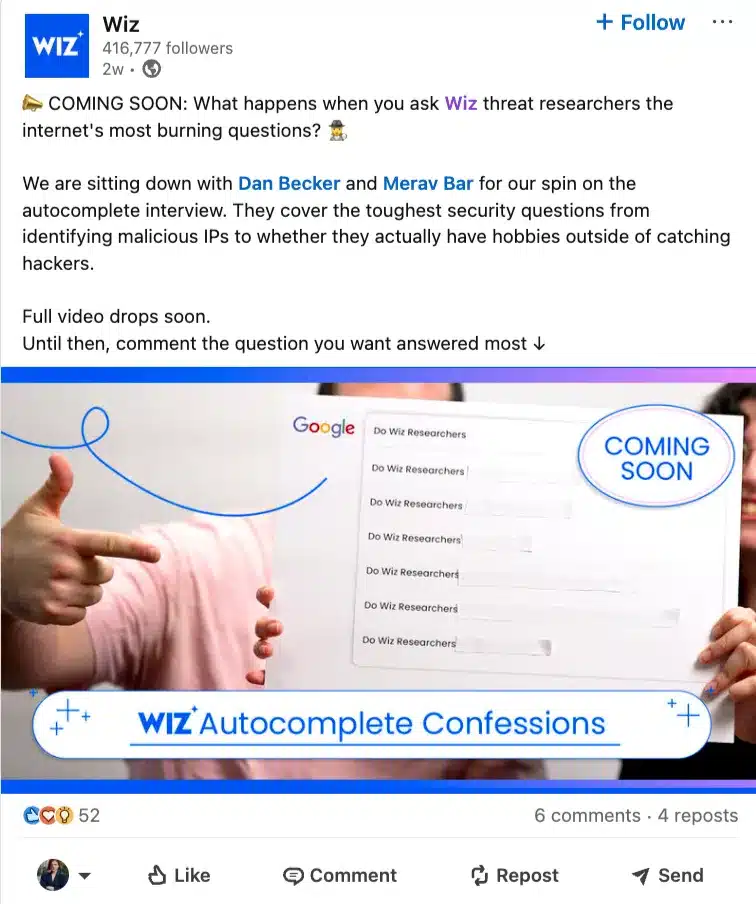
Just as importantly, Wiz makes its experts visible. Instead of only posting from the company account, it regularly puts researchers and engineers in the spotlight through recurring content series, interviews, and videos.
The “Autocomplete Confessions” series is a great example. It takes security experts, adds a light-hearted format inspired by Google’s autocomplete suggestions, and makes technical knowledge much more approachable.
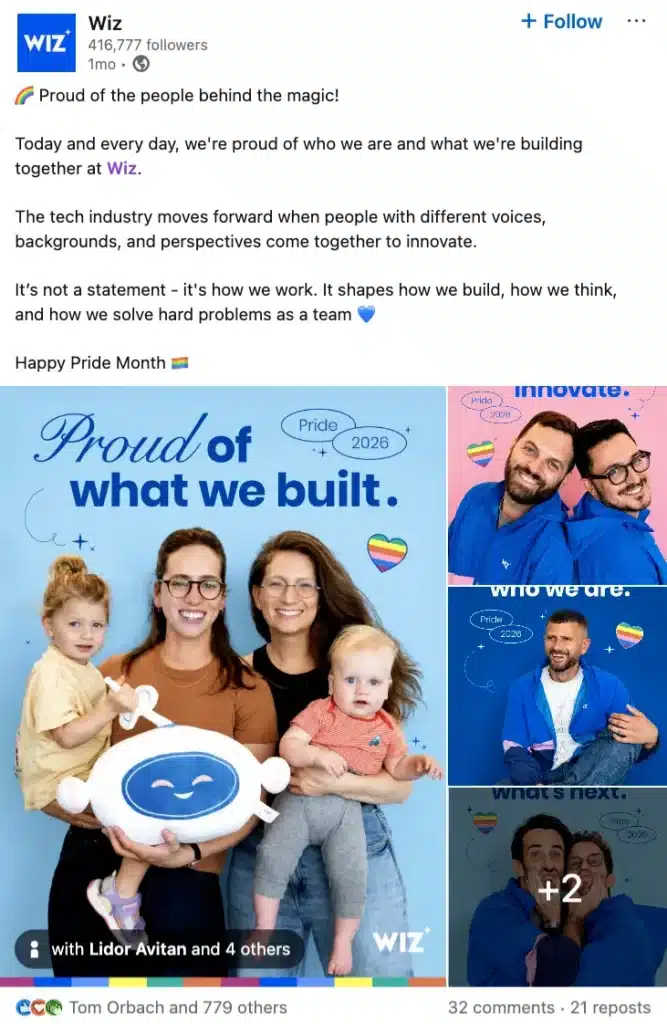
The company also isn’t afraid to show its personality. Alongside research and industry news, you’ll find posts celebrating employees, company culture, and community initiatives. It creates a feed that feels human, without losing credibility.
What you can learn from Wiz
- Turn technical expertise into stories people can easily understand.
- Create recurring content series that people recognize and look forward to.
- Let your employees become the faces of your brand.
- Mix educational content with culture, personality, and behind-the-scenes moments so your feed feels varied instead of repetitive.
2. tl;dv
tl;dv is an AI meeting assistant that records meetings, generates transcripts and summaries, and helps teams find important moments without having to rewatch entire calls. Since the product is built around meetings and workplace productivity, almost everything they post ties back to those themes.
What makes their LinkedIn strategy stand out is that they don’t market the product in a traditional way. Instead of constantly talking about features, they create content that anyone who spends their day in meetings can relate to. You’ll find workplace jokes, memes, videos,conference content, and light-hearted observations alongside product updates.
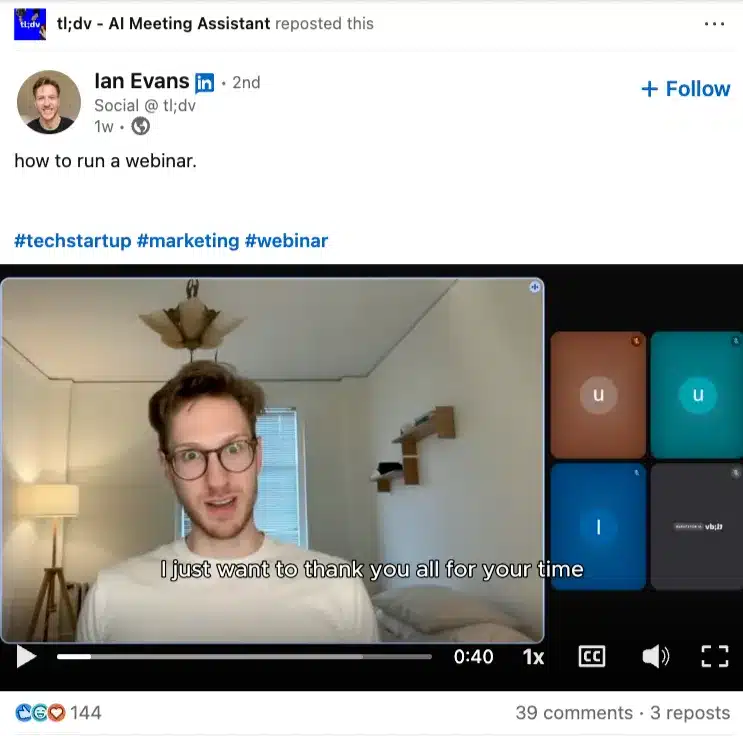
Another thing tl;dv does really well is making its employees part of the brand. Team members like Renée Shaw and Ian Evans have become familiar faces on LinkedIn, regularly sharing content that’s then reposted by the company page.
Rather than building separate personal brands, their content strengthens the tl;dv brand itself. It creates a consistent voice and makes the company feel much more human.
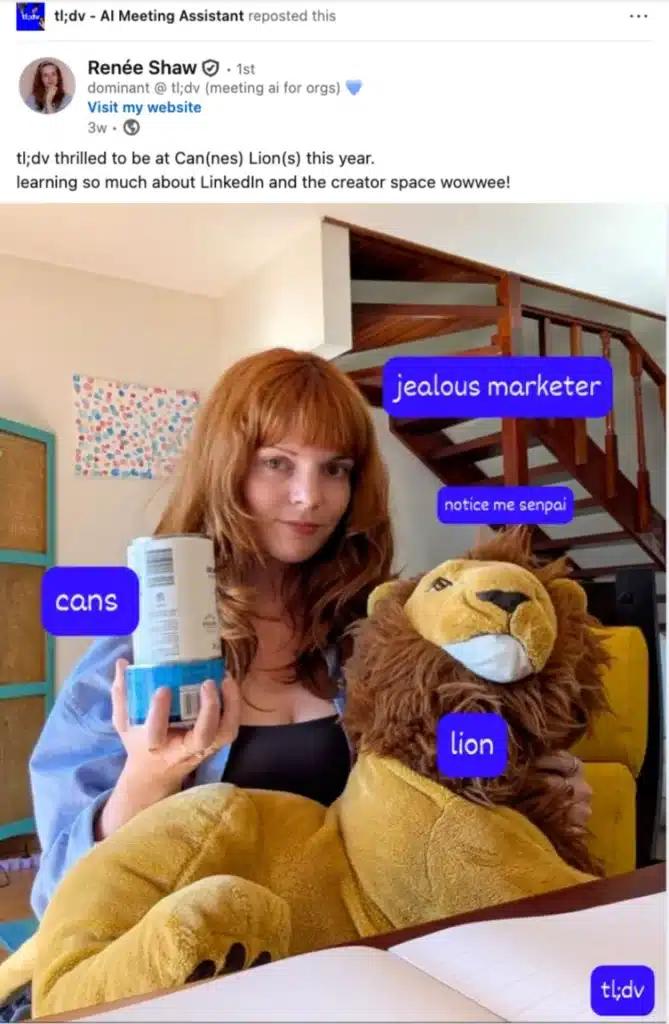
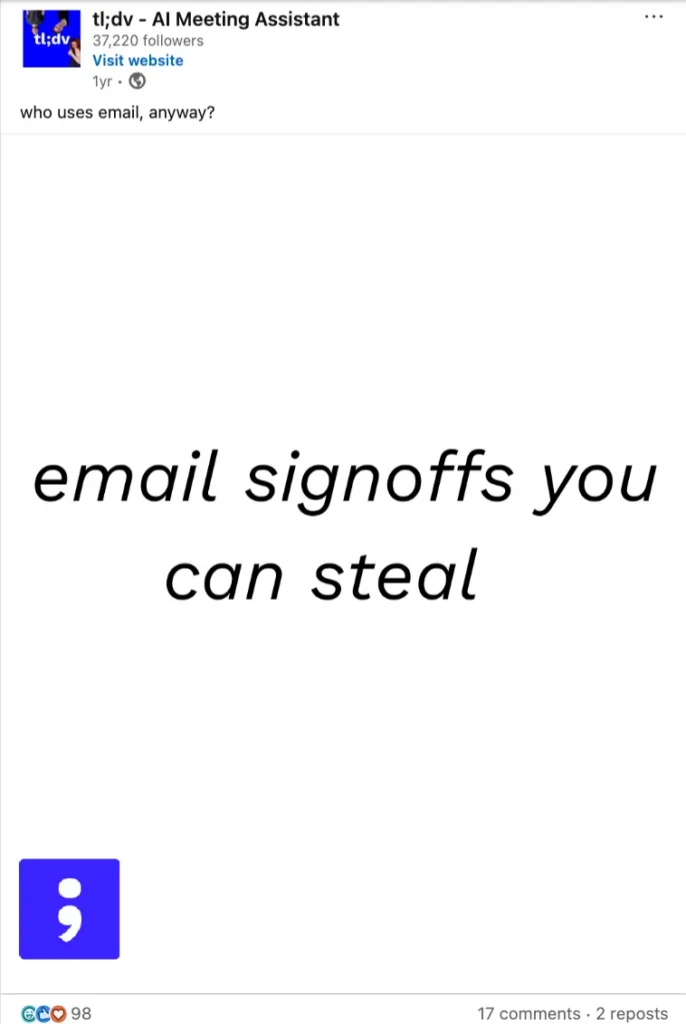
The content is also refreshingly simple. A joke about email sign-offs. A funny post from Cannes Lions. A webinar promoted through a casual video instead of a polished advertisement. It never feels like they’re trying too hard, and that’s exactly why it works.
What you can learn from tl;dv
- Make your content about your LinkedIn audience’s everyday experiences, not just your product.
- Give employees a visible role in your content strategy.
- Use humor and internet culture when it fits your brand.
- Keep your content simple, relatable, and easy to engage with.
3. Ramp
Ramp is a finance automation platform that helps businesses manage corporate cards, expenses, accounts payable, procurement, and financial operations in one place. It’s not the most exciting category on paper, but you’d never guess that from their LinkedIn page.
Instead of talking about finance software, Ramp talks about the problems finance teams deal with every day. Expense policies, approvals, company spending, reimbursements, procurement, and budgeting become the starting point for content that feels useful instead of promotional.
One thing Ramp does particularly well is product marketing. Rather than announcing a new feature, they build a story around the customer problem first.
When launching a solution for construction companies, they introduced “Carl the Controller”, a fictional character dealing with disconnected systems and messy expense management. The product naturally becomes the solution, instead of the entire story.

They also know when to keep things simple. A post pointing out that “Reasonable expenses” isn’t actually a policy turns into an educational conversation about building better expense policies, while still showcasing one of their tools.
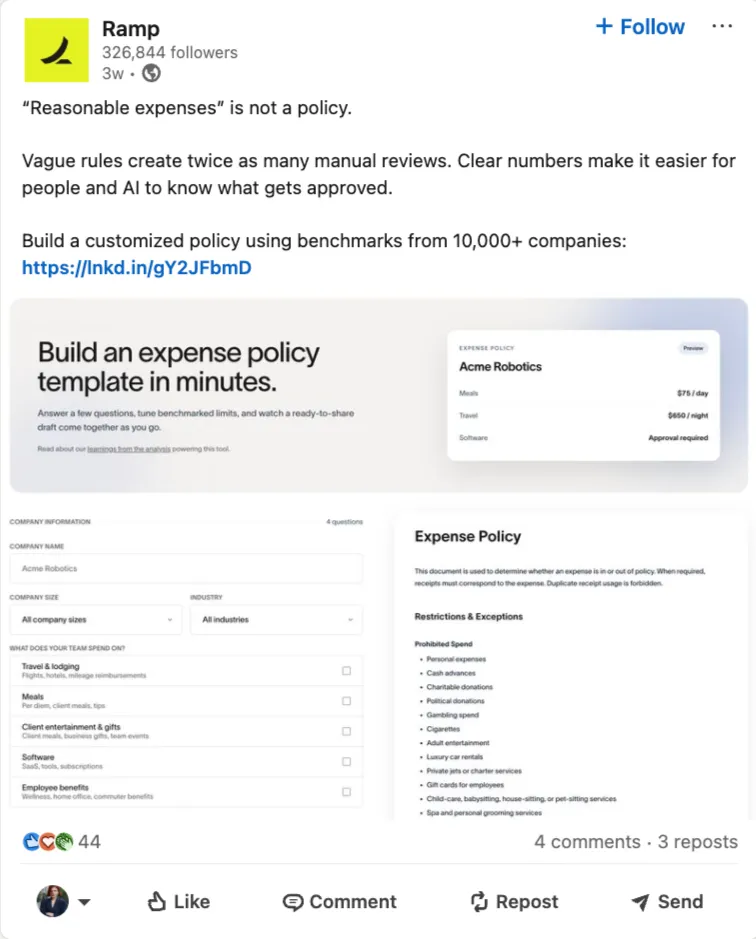
And mixed between educational content are lighter posts that tap into internet culture, like joking that someone wearing Meta’s smart glasses probably “expensed these.” It has nothing to do with expense management on the surface, but it immediately connects the joke back to their product.

Ramp understands that not every post has to sell. Some educate, some entertain, and some promote the product. That mix keeps their feed interesting without making it feel like a constant stream of advertisements.
What you can learn from Ramp
- Start with the customer’s problem, then introduce your product as the solution.
- Turn product launches into stories instead of feature announcements.
- Use humor when there’s a natural connection to your brand.
- Mix educational, promotional, and lighter content to keep your audience engaged.
4. Ahrefs
Ahrefs is best known as an SEO platform, but its LinkedIn strategy goes well beyond search engine optimization. Instead of focusing on product promotion, the company uses LinkedIn to share original research, educate marketers, and showcase the expertise of its team.
One of Ahrefs’ biggest strengths is its original research. The team regularly publishes studies based on its own data, then turns those findings into LinkedIn posts, visuals, videos, and discussions.
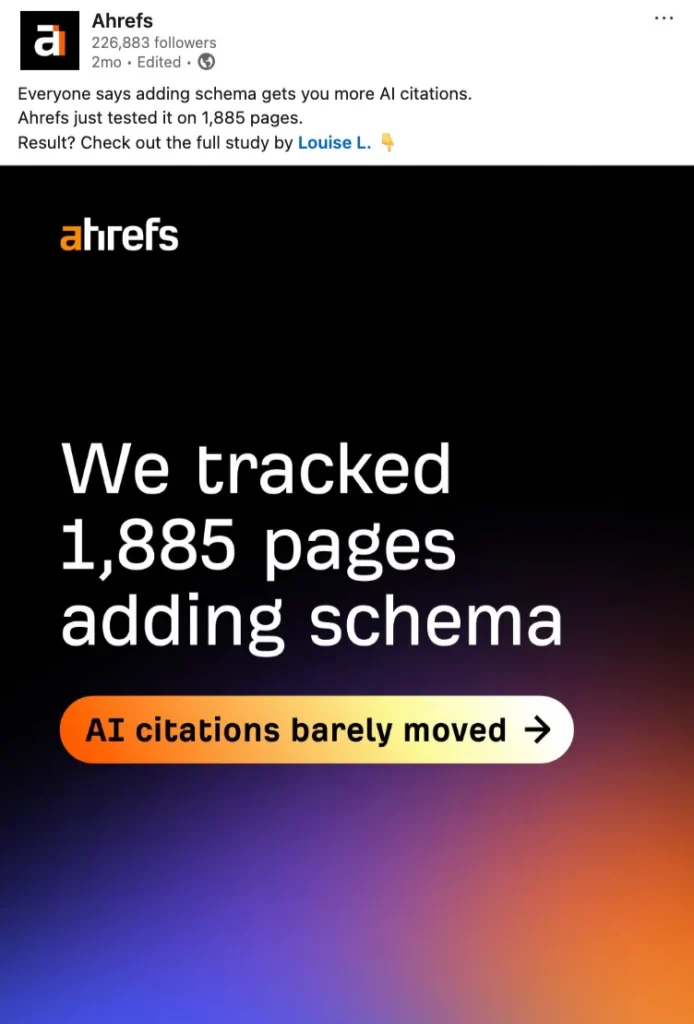
By leading with useful insights instead of product messaging, Ahrefs positions itself as an industry authority while creating content that’s naturally shareable.
Ahrefs also encourages employees to build their own presence on LinkedIn. Team members like Ryan Law regularly share experiments, lessons, and practical frameworks, helping position both themselves and Ahrefs as trusted voices in the marketing space.
Instead of relying only on a company page, Ahrefs grows its reach through multiple experts who consistently contribute valuable content.
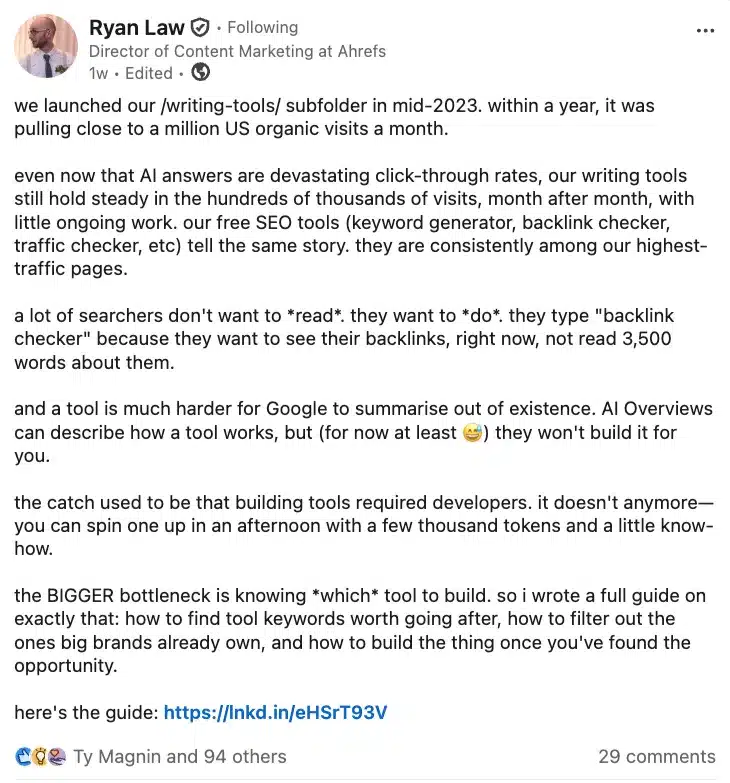
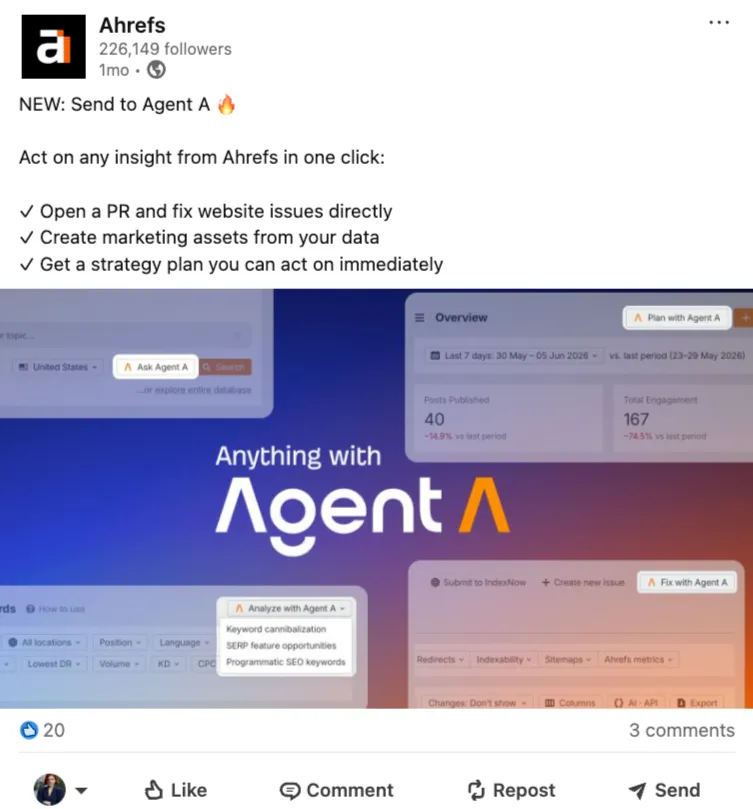
One thing Ahrefs does particularly well is launching new features by focusing on the outcome first. Instead of listing technical capabilities, they explain what users can achieve, then introduce the product as the solution.
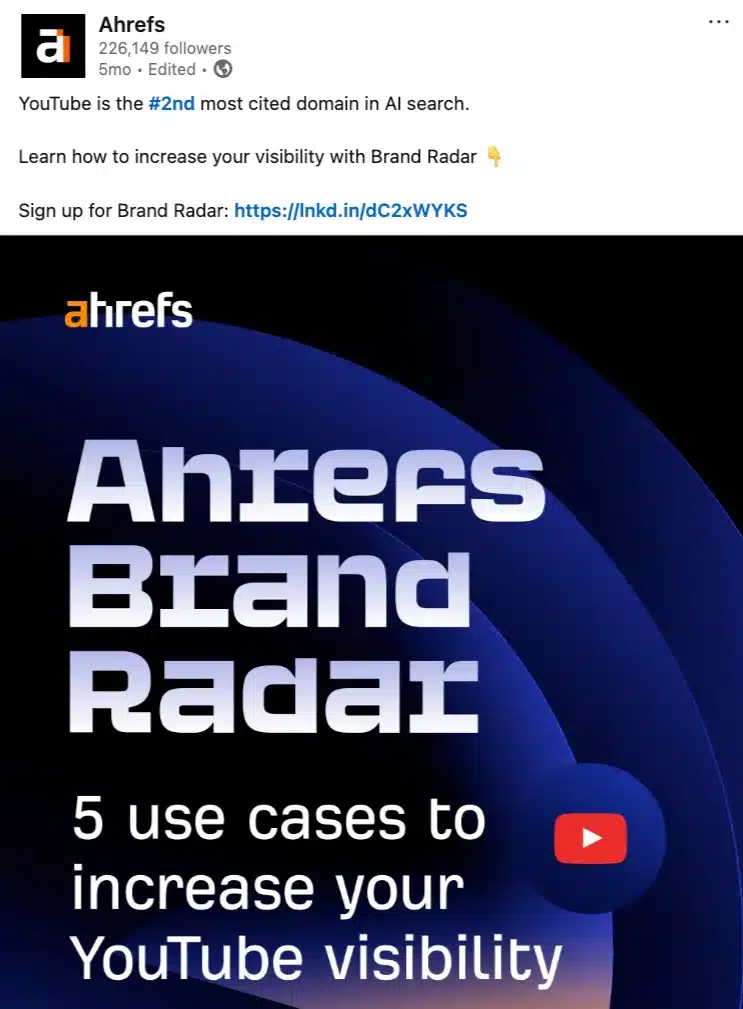
The same approach appears in launches like Brand Radar. Rather than simply announcing a feature, they explain why YouTube visibility in AI search matters first, making the product feel like a natural next step instead of a sales pitch.
Across their page, you’ll notice another pattern: almost every product post is tied to a topic marketers are already discussing, whether that’s AI search, SEO, or content marketing.
What you can learn from Ahrefs
- Publish original research your audience will want to reference.
- Turn one study into multiple LinkedIn posts and formats.
- Encourage employees to build personal brands alongside your company page.
- Lead with the problem or outcome before introducing your product.
- Teach something useful before promoting your solution.
5. Deel
Deel helps companies hire, pay, and manage teams around the world, but its LinkedIn content is much broader than HR or payroll.
Instead of focusing on product features, Deel creates content around the world of work. Remote work, hiring trends, company culture, vacation habits, and workplace data all become topics that their audience genuinely wants to read about.
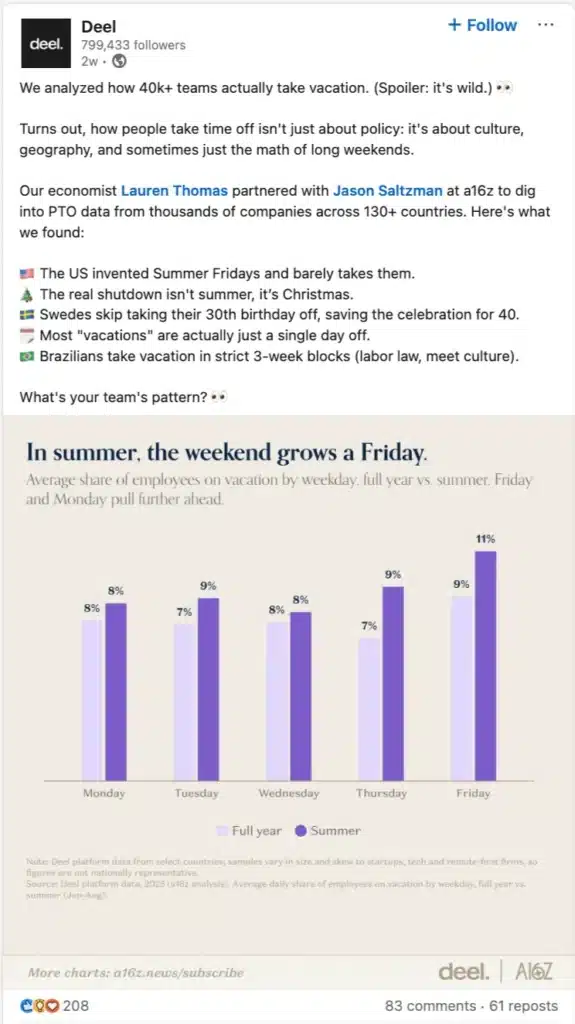
One thing Deel does particularly well is turning original data into engaging content. In one post, they analyzed how more than 40,000 companies take vacation around the world and shared surprising insights, like how Americans rarely use Summer Fridays or how Brazilians typically take three-week vacations. It’s educational, backed by real data, and naturally encourages people to compare it with their own workplace.
They also know how to build campaigns that people want to participate in. Their “Bless This Desk” giveaway invited people to share photos of their worst work-from-home setup for a chance to win a $2,000 makeover. Instead of simply asking people to like a post, Deel got hundreds of people actively contributing in the comments with their own photos.
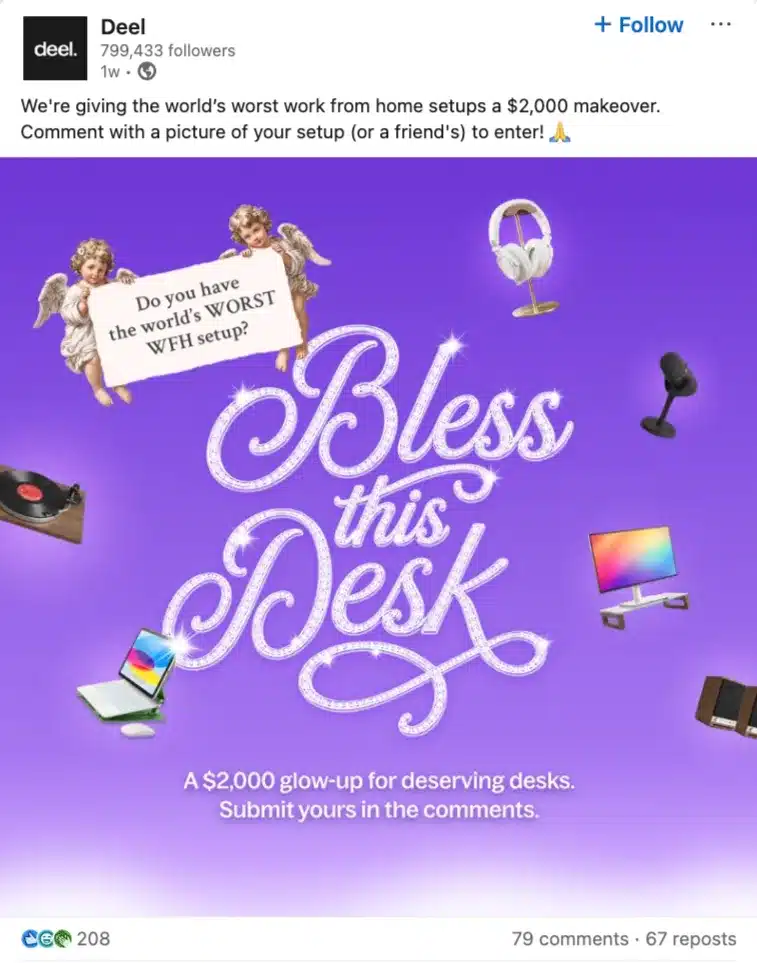
That’s what makes their LinkedIn strategy so effective. They combine original research, community campaigns, and relatable workplace content instead of relying on product announcements. Even when they’re promoting their platform, the content feels useful or entertaining first.
What you can learn from Deel
- Turn your own data into interesting stories and industry insights.
- Create campaigns that encourage people to participate, not just read.
- Build content around your audience’s everyday experiences, not only your product.
- Mix research, community engagement, and product marketing to keep your feed interesting.
How I build a LinkedIn content strategy that works in 2026
There isn’t a single formula for success on LinkedIn, but there are a few habits that the best brands consistently get right. Before worrying about formats, hooks, or the algorithm, it’s worth building a strategy that supports your business goals and gives your content a clear direction.
Here’s how to build a LinkedIn content strategy in 2026, based on learnings from best brands:
- Get painfully clear on who the content is for
- Decide what role LinkedIn plays in the bigger business strategy
- Build content pillars around a few repeatable themes
- Focus on having a point of view instead of trying to sound smart
- Write LinkedIn posts that feel human
- Stop treating every post like a sales pitch
- Rotate between different content formats
- Build a content calendar before I “need content”
- Optimize my LinkedIn profile before chasing visibility
- Focus heavily on conversations, not just posting
- Create content with the LinkedIn algorithm in mind
- Track what actually creates momentum
- Repurpose content instead of reinventing everything
- Use SocialBee to organize my LinkedIn content strategy
Step 1: I get painfully clear on who the content is for
One of the biggest reasons LinkedIn content falls flat is because it’s written for everyone.
If your target audience is simply “businesses” or “marketing professionals,” your posts will probably be too broad to resonate with anyone. The best LinkedIn content feels personal because it’s written with one specific reader in mind.
Before I think about topics, hooks, or formats, I define exactly who I want my content to attract. That might include:
- Ideal clients
- C-suite decision-makers
- Founders
- Marketers
- Potential partners
Then I dig into what matters to them.
What challenges are they facing? What questions do they keep asking? What would make them stop scrolling and think, “This is exactly what I needed to read today”?
Understanding your audience’s pain points should always come before brainstorming content ideas. If you know what your audience cares about, you’ll never run out of things to write about.
For example, if your audience is founders, they might care about growth, hiring, fundraising, or productivity. If you’re targeting marketers, they may be looking for campaign ideas, new tools, or ways to improve performance. Those insights become the foundation of your content strategy.
The more specific your audience is, the easier it becomes to write posts that feel relevant. That’s why the best LinkedIn content often reads as though it was written for one person, even if thousands of people end up seeing it.
Step 2: I decide what role LinkedIn plays in the bigger business strategy
Posting on LinkedIn shouldn’t be a goal on its own. Every post should support something bigger that’s happening in your business.
Before creating content, I ask myself one simple question: What am I trying to achieve? That answer shapes everything that comes next.
Depending on the business, the goal might be:
- Thought leadership
- Lead generation
- Personal brand growth
- Company visibility
- Building relationships with customers, partners, or future hires
For example, a founder trying to attract investors will create very different content from a SaaS company looking to generate demo requests. Likewise, a business focused on hiring should spend more time showcasing its people and company culture than talking about product features.
Once your goal is clear, it becomes much easier to decide what topics to cover, which stories to tell, and how you’ll measure success.
Step 3: I build content pillars around a few repeatable themes
One of the biggest misconceptions about LinkedIn is that you need a completely new idea every time you post.
You don’t.
The brands that consistently perform well tend to talk about the same core topics over and over. The difference is that they approach those topics from different angles. That’s what makes their content recognizable.
I like to build my strategy around a handful of content pillars that are closely connected to the business.
Some of the themes I see performing well again and again on LinkedIn include:
- Client wins
- Customer quotes
- Industry insights
- Lessons learned
- Strong opinions
- Company culture
- Market observations
For example, a customer success story can become a case study one week, a customer quote the next, and a lesson learned a few weeks later. You’re not repeating yourself. You’re giving people another way to understand the same idea.
Having a few clear content pillars also makes planning much easier. Instead of wondering what to post every Monday morning, you already have a framework to work from.
Don’t be afraid to revisit the same topics. Most people won’t see every post you publish, and even if they do, repetition helps build recognition. Over time, your audience starts to associate your brand with a few specific themes, and that’s exactly what a strong content strategy should do.
Step 4: I focus on having a point of view instead of trying to sound smart
Most LinkedIn posts aren’t bad. They’re just forgettable.
You see the same advice over and over again:
“Consistency is key.”
“Know your audience.”
“AI is changing everything.”
None of those statements are wrong, but they also don’t give people a reason to stop scrolling.
The brands that stand out aren’t afraid to have an opinion. They explain why they believe something, challenge common assumptions, or offer a fresh perspective on a topic everyone is talking about.
That’s what thought leadership really is. It doesn’t come from posting motivational quotes or trying to sound like the smartest person in the room. It comes from sharing experiences, observations, and ideas that people can’t get anywhere else.
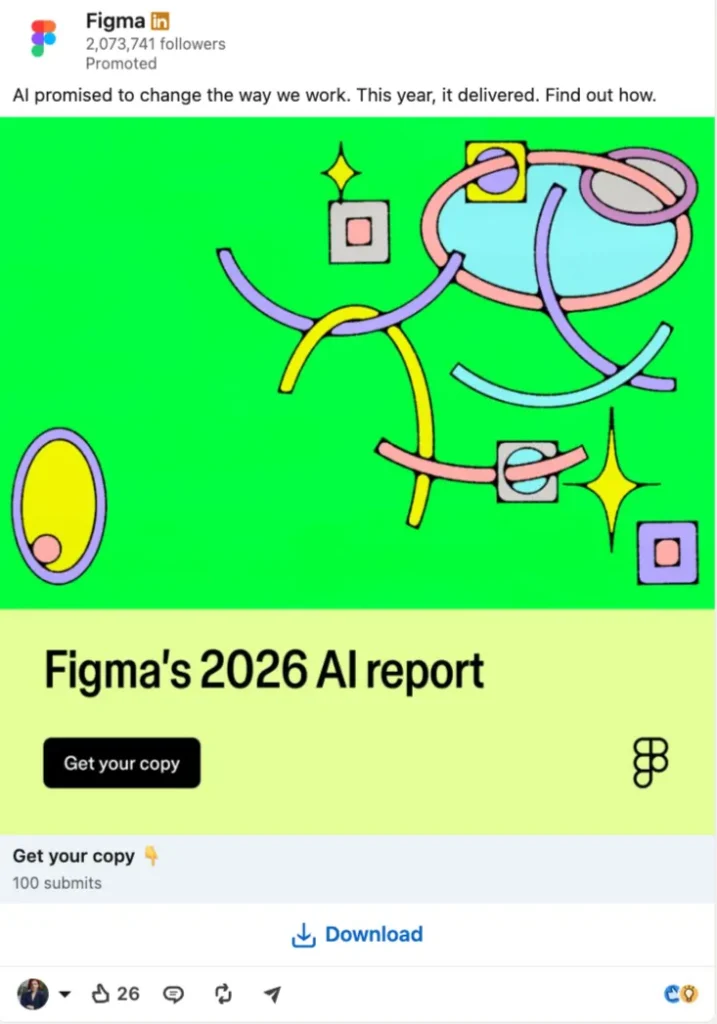
Take Figma, for example. Instead of promoting another AI feature, they launched their AI report with a simple statement: “AI promised to change the way we work. This year, it delivered.” Rather than jumping on the AI hype, they took a clear position and backed it up with original research. It’s a much stronger approach than simply saying, “Download our latest report.”
The biggest mistake I see on LinkedIn is brands trying to sound impressive instead of saying something interesting. Long posts full of buzzwords rarely start conversations. Clear opinions do.
That doesn’t mean you need to be controversial for the sake of it. Sometimes having a point of view is as simple as explaining why your team approaches something differently or sharing a lesson you’ve learned that goes against conventional advice.
If someone finishes reading your post and thinks, “That’s an interesting way to look at it,” you’ve done your job. That’s the kind of content people remember and come back for.
Step 5: I write LinkedIn posts that feel human
One of the easiest ways to make your content stand out is to stop writing like a company.
People connect with people. They don’t connect with buzzwords, corporate jargon, or paragraphs that sound like they were copied from a press release.
I keep my writing simple. Short paragraphs, everyday language, and a clear point. If I wouldn’t say something out loud, I probably wouldn’t write it either.
That’s also why text-only posts still do so well on LinkedIn. You don’t always need a polished design or an expensive video. If you have an interesting story, a useful lesson, or a strong opinion, people will read it.
I also try to write from my own experience whenever I can. Instead of saying, “Businesses should do X,” I’ll explain what happened, what I learned, and why I’d do things differently next time. Those kinds of posts feel much more genuine because they come from a real experience.
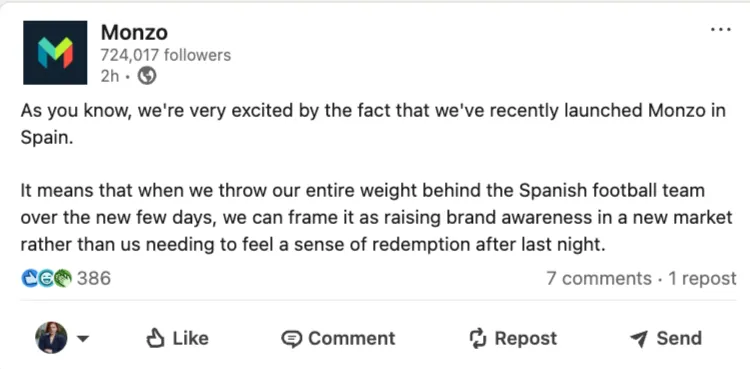
Monzo does this really well. When they launched in Spain, they could have posted a typical announcement. Instead, they joked about the Spanish football team’s disappointing result and tied it back to their expansion. It was relevant, funny, and sounded like it was written by a person, not a brand. The product wasn’t the focus. The story was.
That’s usually the balance I aim for. Teach people something, but let your personality come through too. Those are the posts people remember.
Step 6: I stop treating every post like a sales pitch
One of the quickest ways to lose people on LinkedIn is to make every post about your product.
People don’t open LinkedIn looking for advertisements. They open it to learn something new, laugh at a relatable situation, or hear what other professionals think. If every post is a promotion, people quickly tune out.
The brands that do well on LinkedIn understand this. They spend much more time building familiarity than asking for a sale.
A great example is Dapper. Although it’s a demand generation agency, much of its content isn’t about its services at all. Instead, it shares relatable marketing memes, observations from working with clients, and opinions on common industry challenges.

That’s the point.
By consistently publishing content people enjoy, Dapper builds credibility long before someone needs an agency. When that moment comes, they’re already top of mind.
That doesn’t mean you should never promote your business. You absolutely should. But promotions work much better when they’re surrounded by content that educates, entertains, or starts conversations.
A good rule is to ask yourself one question before publishing:
“Would someone still find this interesting if they never bought my product?”
If the answer is yes, you’re probably on the right track.
Step 7: I rotate between different content formats
Not every idea should become a text post.
Sometimes a carousel explains a topic much better. A short video can show more personality than a paragraph ever could. A customer quote might work best as a simple graphic, while a product update is easier to understand through a screenshot or screen recording.
That’s why I like mixing formats throughout the month.
Some of the LinkedIn formats I use most are:
- Text posts
- Carousels
- Videos
- Images
- GIFs
- Polls
- Blog post promotion
- Customer stories
- Company updates
- Screenshots and product demos
Using different formats keeps your feed interesting and helps you reach people who prefer consuming content in different ways. It also gives you more opportunities to repurpose the same idea. For example, a blog post can become a carousel highlighting the key takeaways, a short video explaining the main idea, and a text post sharing your opinion on the topic.
The key is to stay consistent without making your feed predictable.
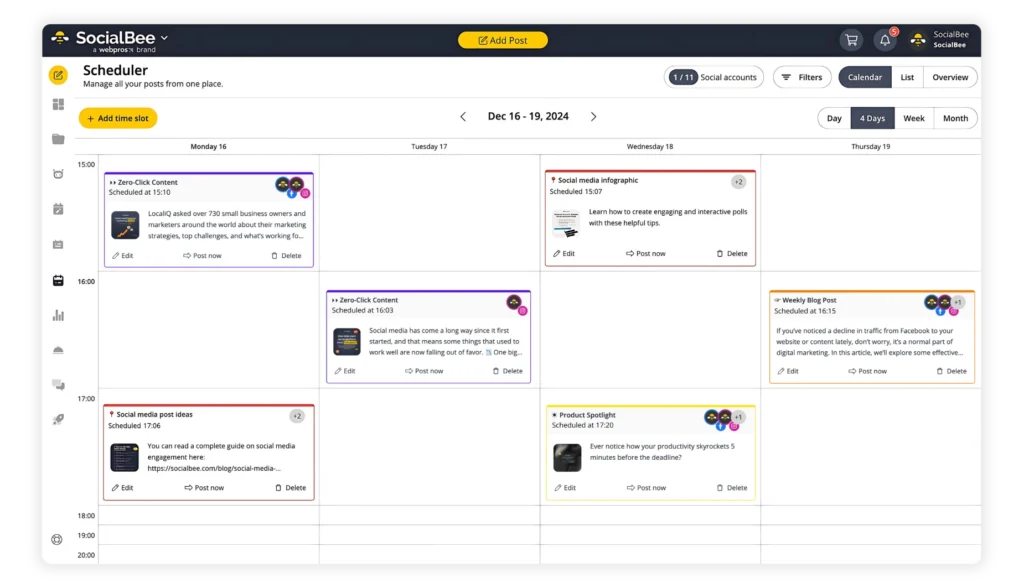
Step 8: I build a content calendar before I “need content”
One of the biggest reasons people struggle with LinkedIn is that they decide what to post five minutes before they want to publish.
That usually leads to one of two things: either you spend an hour staring at a blank page, or you post something just for the sake of staying active.
I prefer to plan content a few weeks ahead.
I start by looking at what’s coming up. That could be a product launch, a webinar, an event, a customer story, a new blog post, or an industry event that everyone will be talking about. Then I build content around those moments instead of scrambling for ideas every week.
Planning ahead doesn’t mean every post has to be scheduled in advance. I always leave room for timely content and industry news. But having a calendar means I already have a strong foundation, so I don’t feel pressured to create something from scratch every few days.
A content calendar also helps you keep a good balance. Instead of accidentally publishing three product updates in one week, you can spread out different topics and formats across the month.
Step 9: I optimize my LinkedIn profile before chasing visibility
Getting people to click on your profile is only half the battle.
What they see when they arrive often determines whether they follow you, visit your website, or leave after a few seconds. That’s why I always recommend optimizing your profile before spending too much time trying to grow your reach.
Think of your LinkedIn profile or company page as a landing page. It should answer a few simple questions straight away:
- Who are you?
- What do you do?
- Who do you help?
- Why should someone follow you?
There are a few areas I always review:
- Profile picture: Use a high-quality, recognizable photo or logo.
- Headline: Make it clear what you do and who you help. Don’t settle for generic titles like “Marketing Specialist.”
- Featured section: Highlight your best content, website, lead magnet, or case studies.
- Company page: Add a complete description, a strong banner, your website, and make sure your branding is consistent.
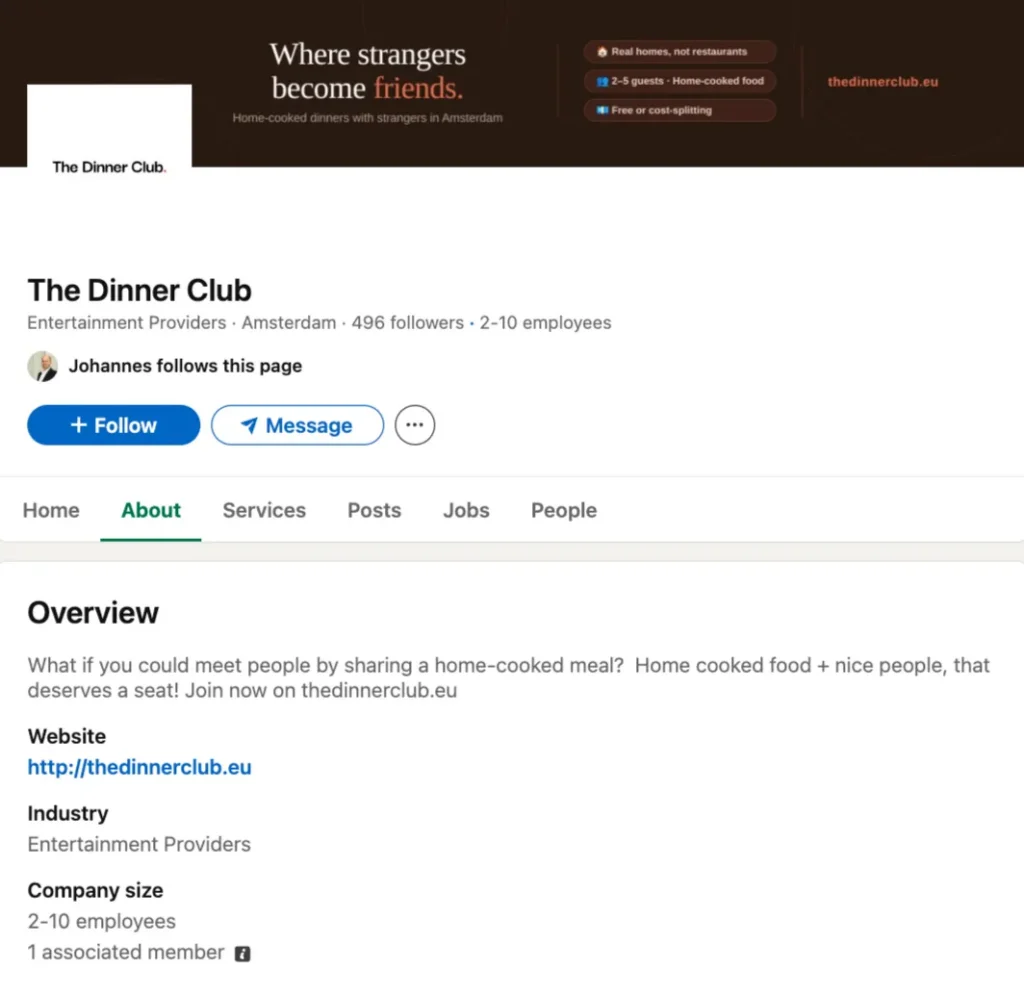
Take The Dinner Club as an example. As soon as you land on their page, you understand what they’re about. Their banner explains the concept in one sentence, highlights the key benefits, and includes the website. The page immediately answers the question, “Why should I care?” before you’ve even scrolled down.
A strong profile also makes your content work harder. If someone enjoys one of your posts, they’ll often click through to learn more. If your profile is incomplete or confusing, you risk losing that opportunity.
A few small improvements to your profile can make every future LinkedIn post more effective.
Step 10: I focus heavily on conversations, not just posting
A lot of people think LinkedIn success comes from publishing more posts.
In reality, some of the biggest opportunities happen in the comments.
Every comment is a chance to continue the conversation, answer a question, or show your personality. It’s also one of the easiest ways to increase the reach of your content. The more genuine conversations your post creates, the more likely LinkedIn is to keep showing it to other people.
That’s why I never treat publishing as the finish line. Once a post goes live, I make time to reply to comments, ask follow-up questions, and keep the discussion going.
I also try to be active on other people’s posts. Leaving thoughtful comments is one of the fastest ways to build relationships and get your name in front of the right audience without creating new content.
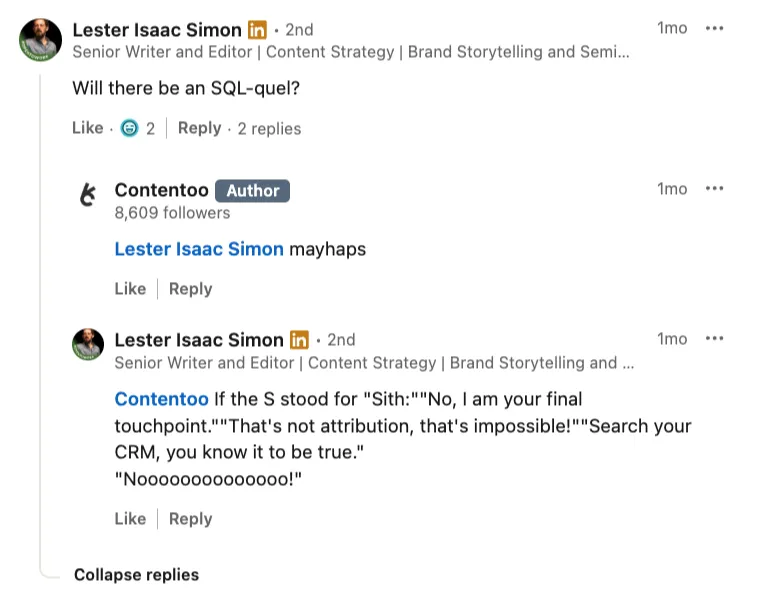
Some brands even turn the comments into part of their content strategy. A great example is Contentoo. Instead of replying with a simple “Thanks!”, they respond with jokes, references, and conversations that feel just as entertaining as the original post. People end up reading the comments because they’re genuinely fun, and that creates even more engagement.
The brands that do well on LinkedIn don’t just publish content. They participate in the conversations that follow.
Pro tip: Set aside 15 to 20 minutes after publishing a post to reply to comments while engagement is highest. It’s one of the simplest ways to increase visibility and build stronger relationships with your audience.
Step 11: I create content with the LinkedIn algorithm in mind
You don’t need to understand every detail of the LinkedIn algorithm to create posts that perform well.
At its core, the algorithm tries to show people content they’re likely to find valuable. It looks at early engagement signals such as reactions, comments, shares, and dwell time (how long people spend reading your post), then decides whether to show it to a wider audience. The more meaningful interactions your content generates, the further it can spread.
The first sentence is especially important. It’s what makes someone stop scrolling and decide whether your post is worth their attention. I try to avoid clickbait and instead lead with something specific, timely, or intriguing.
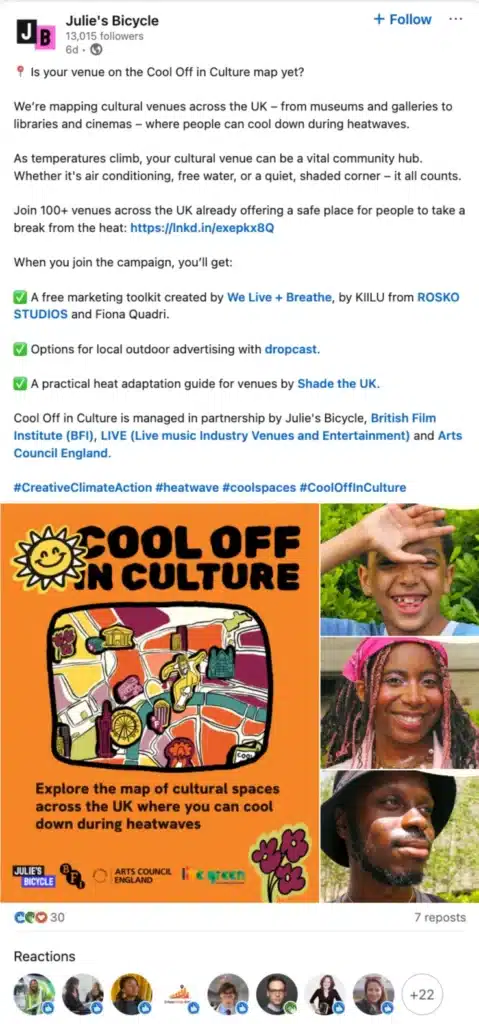
A great example comes from Julie’s Bicycle. Their post starts with a simple question: “Is your venue on the Cool Off in Culture map yet?” If you’re part of their target audience, you’re immediately curious. It tells readers exactly who the post is for without relying on exaggerated claims or vague promises.
Once people are reading, good formatting helps keep them there. Short paragraphs, enough white space, and simple language make even longer posts easy to get through.
I also use hashtags, but sparingly. A few relevant hashtags can help people discover your content, especially if you’re posting about a niche topic or an event. Adding ten or twenty hashtags at the end of every post rarely adds much value.
The biggest mistakes I see are surprisingly simple:
- Starting with a weak first sentence.
- Writing long walls of text.
- Using clickbait that doesn’t deliver.
- Stuffing posts with hashtags.
- Publishing without giving people a reason to engage.
The algorithm changes all the time. Good writing doesn’t. If you focus on getting people to
Step 12: I track what actually creates momentum
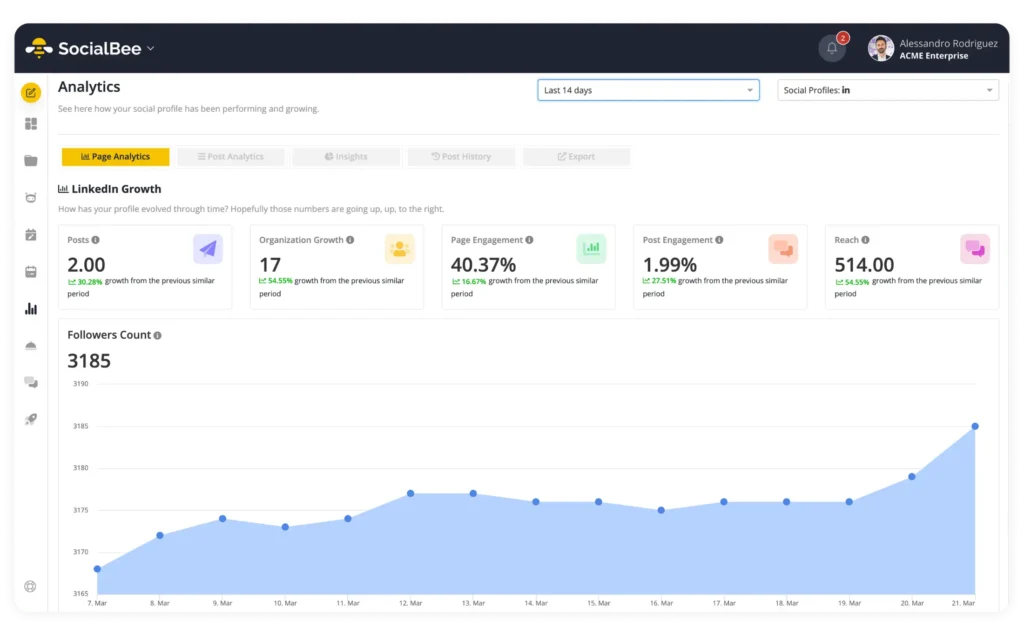
I don’t spend much time worrying about whether a post gets 10,000 or 100,000 impressions.
I’m much more interested in what happens after someone reads it.
Did people leave thoughtful comments? Did they save it for later? Did they visit my profile? Did someone send me a message because of it?
The LinkedIn metrics I look at most are:
- Engagement
- Profile visits
- Comments
- Saves
- Follower growth
- Inbound leads
After a while, you start noticing patterns.
Maybe customer stories consistently bring in leads. Maybe your opinion pieces get shared the most. Maybe your educational posts drive profile visits. Those patterns are much more useful than chasing a viral post.
I also don’t think it’s helpful to obsess over every post. Sometimes content performs well weeks after it’s published. What matters is looking at your results over time and asking yourself one simple question:
“What does my audience keep responding to?”
Step 13: I repurpose content instead of reinventing everything
One of the biggest mistakes I see is people believing they need a brand new idea for every LinkedIn post.
You don’t.
The best brands are constantly repurposing content. They know that creating something valuable takes time, so they make sure it reaches people in more than one format.
A webinar can become several LinkedIn posts. A podcast episode can be turned into short video clips, quote graphics, carousels, and blog articles. A customer interview can become a case study, a founder story, and a series of social posts.
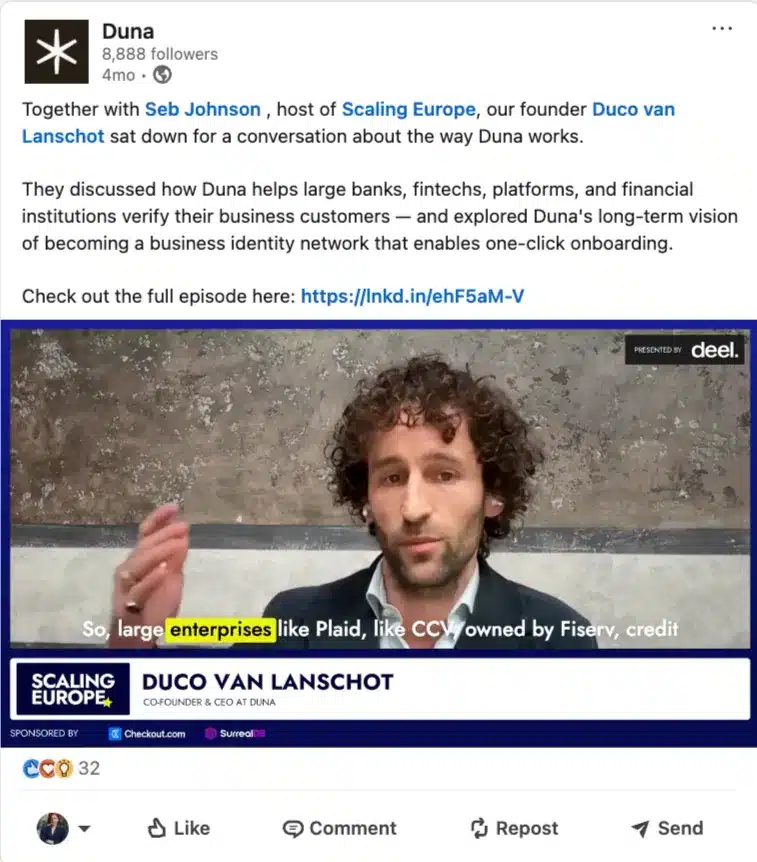
Duna does this well. Instead of simply sharing a podcast episode featuring its founder, the company promotes clips from the conversation across LinkedIn. The same discussion becomes multiple pieces of content that introduce new audiences to the business without requiring the team to create something entirely new each time.
Repurposing also helps you meet people where they are. Some people will read a blog post. Others would rather watch a 30-second video or scroll through a carousel. The core message stays the same, but the format changes.
That’s why top brands rarely create every post from scratch. They spend more time getting the most out of their best ideas than constantly chasing new ones.
Step 14: I use SocialBee to organize my LinkedIn content strategy
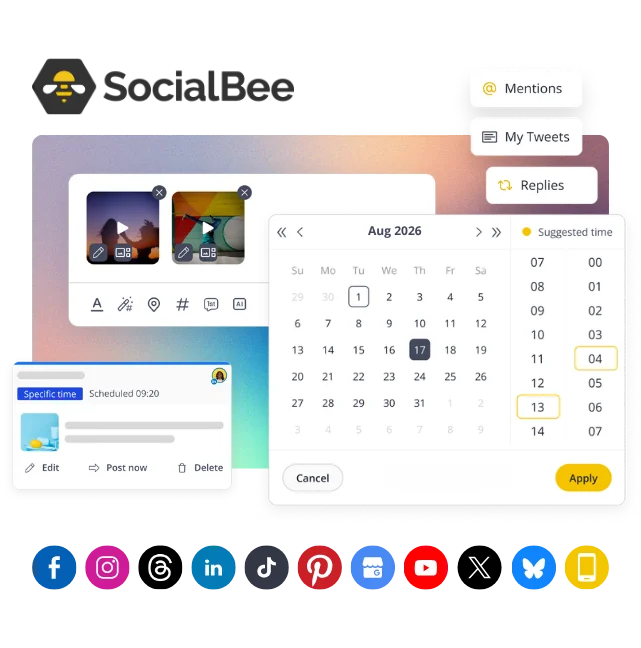
Once I know what I want to say, I move everything into SocialBee. Instead of switching between Google Docs, Canva, LinkedIn, spreadsheets, and a dozen browser tabs, I manage my entire LinkedIn workflow from one place.
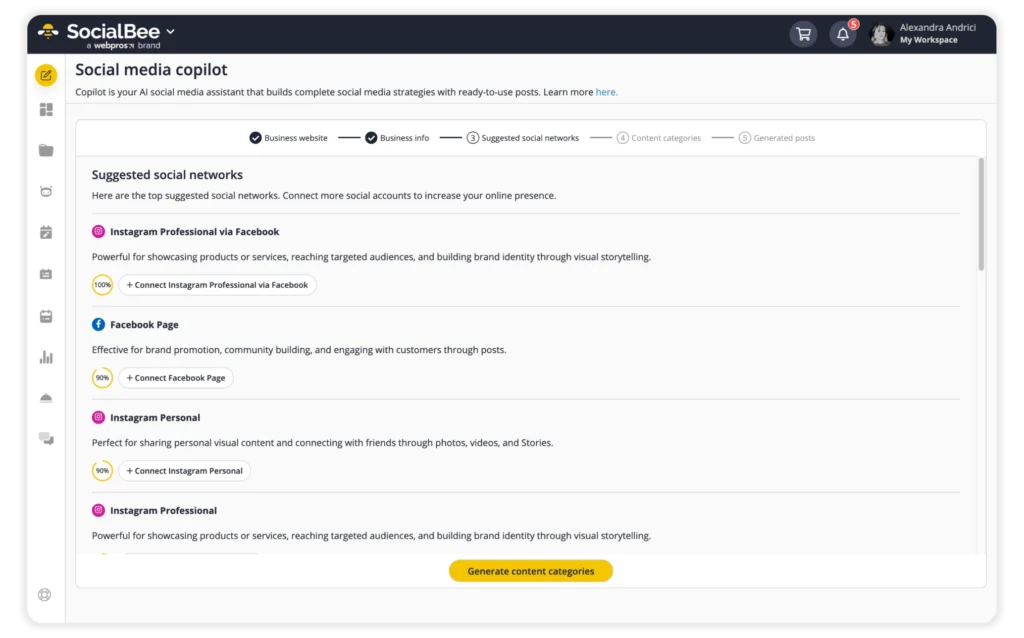
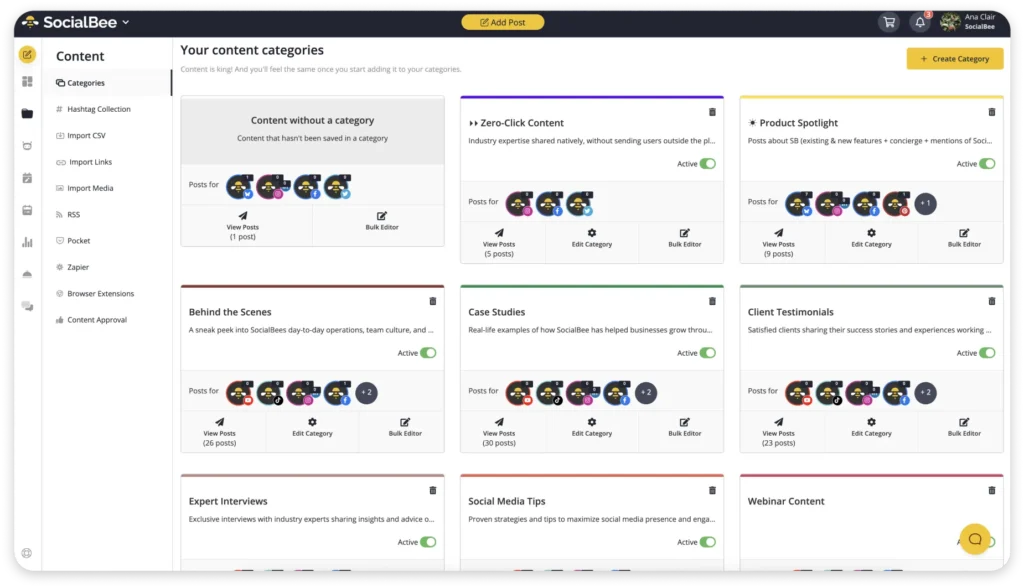
I usually start by building my content plan for the month. I organise my post ideas into content categories such as educational, thought leadership, behind the scenes, promotional, and personal content. This helps me quickly see whether my content mix is balanced instead of accidentally publishing five educational posts in a row.
If I’m still developing an idea, I’ll often use SocialBee’s AI tools to speed up the creative process. Sometimes I only have a rough topic, so I’ll ask the AI Copilot to suggest content ideas based on my goals. Other times, I’ll use the AI post generator to create a first draft or generate a few different angles before rewriting everything in my own voice. If I’m creating a carousel or infographic and don’t have the right visual yet, I can even generate images without leaving the platform.