
A Trial Reel is shown to non-followers first, giving you a chance to see how new content performs before deciding whether to share it with everyone.
This piece covers what Trial Reels actually are, how to post one, how to turn a single test into an ongoing testing habit, and what to check when one does not show up as expected.
The feature works best as a repeatable method rather than a one-time trick. By testing different ideas and looking for patterns in the results, you can use Trial Reels to make better decisions about what to create next and build a stronger Reels strategy.

We’re SocialBee LABS SRL, part of WebPros. We use the information you provide to share relevant content & updates, as outlined in our Privacy Policy. You can opt out anytime.
Short summary
- A Trial Reel is shown first to non-followers and stays out of the main profile grid while it is being tested.
- Followers can still occasionally come across a Trial Reel if someone shares it with them directly or if they find it through content that uses the same audio, location, or filter.
- Key performance metrics become available about 24 hours after posting. You can then decide whether to share the Reel with everyone, or let Instagram automatically share it if it performs well within the first 72 hours.
- Trial Reels are useful for testing new ideas and experiments, not launches, promotions, or anything time-sensitive.
- The real value comes from running several tests and looking for patterns, rather than judging your strategy based on a single Reel.
What are Instagram Trial Reels?
A Trial Reel is a Reel shown first to non-followers, kept off the main profile grid while it is being tested. Unlike a regular Reel, it isn’t shown to your followers in their Feed or Reels tab at first, giving you a chance to see how the content performs with a new audience before deciding whether to share it more widely.
A follower can still stumble across one occasionally, most often through a DM share or a page built around the same audio, location, or filter. About 24 hours after posting, you can see key performance metrics, including views, likes, comments, and shares. You can then share the Reel with everyone or leave it as a trial. If you turn on automatic sharing, Instagram can also share it with your followers if it performs well based on the views it receives within the first 72 hours.
Who can use Instagram Trial Reels?
Instagram made Trial Reels available to everyone in June 2025, expanding the feature beyond the eligible creators who originally had access. You no longer need a specific follower count to get the feature.
If the Trial option doesn’t appear when you’re creating a Reel, first make sure you’re using the latest version of Instagram.
Trial Reels compared with regular Reels
A regular Reel goes to followers and non-followers together from the moment it is posted, appears on the profile grid right away, and reports its performance in real time. A Trial Reel goes to non-followers first, stays off the grid during the test, and holds its performance data until the window closes.
When to use Instagram Trial Reels
Trial Reels suit genuine experiments, not routine posts or anything that already has to go out on a fixed schedule. Good candidates include a new content pillar, an unfamiliar hook style, a different editing approach, a storytelling format the account has not tried, a topic outside the usual lineup, a new kind of call to action, or an older evergreen idea worth testing with a fresh cut.
Once you start seeing patterns in your Trial Reel results, use them to decide what to post more often. For example, if a certain hook or Reel format keeps performing well, you can create more regular Reels using the same approach. You’ll still need Instagram to run the Trial Reels themselves, while SocialBee’s Instagram scheduler can help you put what you learn into practice.
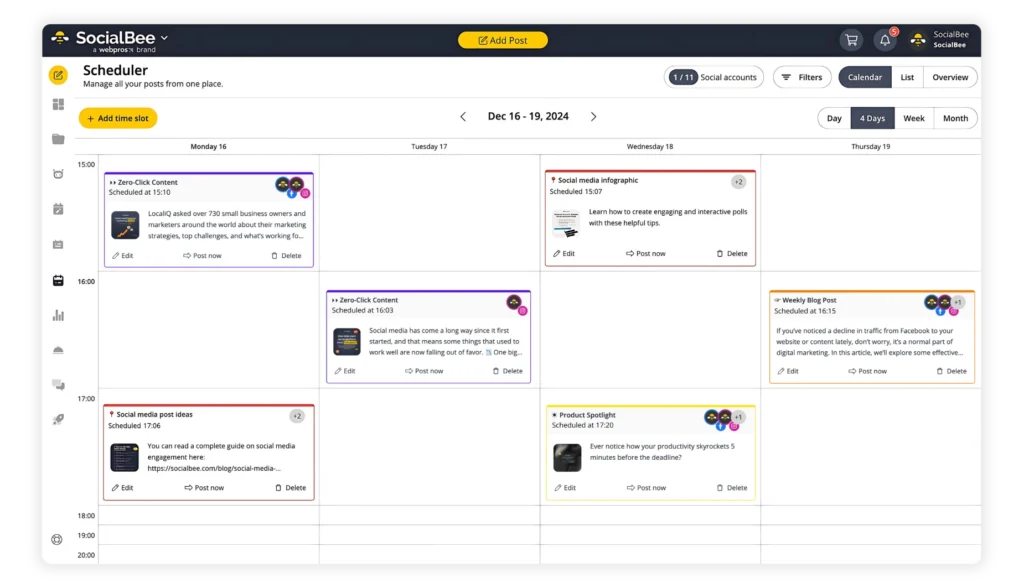
Plan your regular Reels in your content calendar, schedule them for the right dates and times, and have SocialBee publish them automatically. This way, the ideas that perform well in your tests can become a consistent part of your Instagram strategy.
When not to use Trial Reels
Announcements, launches, promotions, and anything tied to a specific date do not belong here, since a Trial Reel is deliberately hidden from followers during the test window, and that is the one audience a time-sensitive post cannot afford to skip.
Post a Trial Reel on Instagram
The Trial toggle sits on the same screen used to publish any Reel, and the choice afterward is between sharing it manually or letting it auto-share if it performs well.
- Create a Reel exactly as usual, edit it, and add a caption.
- On the final sharing screen, find the Trial toggle among the other publishing options and turn it on.
- Choose whether to auto-share the Reel to followers if it clears Instagram’s performance bar, or to decide manually once results are in.
- Publish, then check back once the test window closes to publish, discard, or let the automatic decision stand.
Turn Trial Reels into a testing habit
Trial Reels work best as an ongoing loop, where tests are run and logged repeatedly, rather than as a single one-off check.
1. Start with a clear hypothesis
Decide what the test is actually meant to answer before posting it. A hypothesis such as “A stronger hook in the first two seconds will increase watch time” gives a test something specific to prove or disprove, instead of just seeing what happens.
2. Test one variable at a time
Changing several things in the same test, such as a new hook, a new editing style, and a new topic all at once, makes it impossible to know which change actually moved the numbers. Variables worth isolating one at a time include the hook, the length, the cover image, the caption, the call to action, the audio, the editing style, the storytelling format, or the topic itself.
3. Analyze Trial Reel performance
Views alone don’t tell you whether a test worked. Watch time, likes, comments, shares, and saves can give you a more complete picture, depending on what you were testing. A high watch time with low engagement may suggest that the content held attention but didn’t encourage viewers to take another action. Strong shares with lower watch time may suggest that the idea landed, but the execution could still be improved.
4. Record results and repeat
One Trial Reel proves very little on its own. The value comes from documenting each test, watching for a pattern across several of them, such as a specific hook style consistently outperforming the rest, and using that pattern to shape what gets made next, rather than chasing whatever happened to do well once.
Why Trial Reels sometimes don’t show up
If the Trial option doesn’t appear when you’re creating a Reel, first make sure you’re using the latest version of the Instagram app. Instagram made Trial Reels available to everyone in June 2025, so the missing option should no longer be explained by the original limited rollout or a specific follower-count requirement.
There is no separate Trial Reels app or signup page needed to access the feature. If updating Instagram doesn’t solve the problem, you can also try restarting the app or logging out and back in before reporting the issue to Instagram.
Frequently asked questions
Can personal accounts use Trial Reels?
Instagram announced in June 2025 that Trial Reels had been made available to everyone. However, Meta’s current public documentation does not clearly specify whether this includes every account type and privacy setting. The simplest way to check is to look for the Trial option when creating a Reel.
Can followers see my Trial Reel?
Not through their normal Feed or Reels tab at first. A follower can still occasionally find one through a DM share or through a page built around the same audio, location, or filter.
Should I automatically publish successful Trial Reels?
It depends on how much control matters versus how much time you have to check back. Auto-share works well if you don’t want to review every Trial Reel manually, while manual review works better when timing or final wording still needs a check before it reaches followers.
Should every Reel be a Trial Reel?
No, reserve Trial Reels for genuine tests. A launch, a promotion, or anything tied to a specific date needs to reach followers immediately, which a Trial Reel is built specifically not to do.
How long does a Trial Reel test run before you see results?
Instagram starts showing key performance metrics approximately 24 hours after you post a Trial Reel. If you enable automatic sharing, Instagram can share the Reel with everyone if it determines that it is performing well based on the views it receives within the first 72 hours.
Test smarter with Instagram Trial Reels
Trial Reels make it possible to test new ideas with non-followers before deciding whether to share them with your existing audience. Over time, those tests can help you identify the topics, hooks, and formats worth using more often in your Reels strategy.
Trial Reels themselves need to be published and analyzed through Instagram, but SocialBee can help with what comes next. Once you know which ideas work, you can use SocialBee to plan and schedule your regular Instagram Reels, feed posts, carousels, Stories, and collaborative posts, and track your Instagram performance with analytics over time. This way, you can keep experimenting with Trial Reels while maintaining a consistent Instagram presence.
Start your 14-day SocialBee trial today! No credit card required.