

Social media goals give all the work you put into social media a clear purpose. You can post every day, reach more people, and rack up likes and comments, but if you don’t know what those numbers are supposed to achieve, it’s hard to tell whether your social media efforts are actually helping your business.
In this guide, we’ll walk through how to set social media goals that make sense for your business, the KPIs you should use to track them, and 10 practical goals you can adapt to your own social media strategy.

We’re SocialBee LABS SRL, part of WebPros. We use the information you provide to share relevant content & updates, as outlined in our Privacy Policy. You can opt out anytime.
Short summary
- Social media goals connect your day-to-day activity to outcomes that matter to the business, from brand awareness and community engagement to leads, sales, and customer retention.
- Goals, objectives, and KPIs serve different purposes: the SMART social media goals give the direction, the objective defines the target, and KPIs show whether you’re making progress.
- Strong targets are based on your current performance and available resources, not arbitrary benchmarks or competitor results.
- Each social platform can play a different role in the same goal, so choose KPIs based on what you expect that channel to contribute.
- Focus on a small number of priorities at a time and use performance data to decide when tactics need to change.
What are social media goals?
Social media goals are the broad outcomes you want your social media efforts to contribute to, such as increasing brand awareness, generating leads, or building stronger relationships with your customers. They give your social media marketing plan direction and help you decide what’s worth spending your time and budget on.
Goals, objectives, and tactics are easy to mix up, but each one has a different job:
- Goal: The broad result you want your social media marketing strategy to support. For example, increase brand awareness.
- Objective: A specific, measurable target that shows what progress toward that goal looks like. For example, increase average monthly LinkedIn reach by 20% over the next six months.
- Tactic: The action you’ll take to reach that objective. For example, publish two document social media posts and one expert video each week.
Think of it as a simple chain: your goal tells you where you want to go, your objective tells you what success looks like, and your tactics tell you what you’ll do to get there.
The same distinction matters when you start measuring results. A metric is any number you can track, such as impressions, comments, clicks, followers, or website traffic. A KPI (key performance indicator) is a metric you’ve chosen because it directly shows whether you’re making progress toward a specific objective.
For example, if your goal is brand awareness, reach and impressions could be useful KPIs. The number of email sign-ups might still be a useful metric for your business, but it wouldn’t tell you much about whether more people are seeing your brand.
That’s why you don’t need to treat every number in your social media analytics as equally important. Choose a small set of KPIs that match each goal, then use them to track progress and decide whether your social strategy is working.
Why do you need social media goals?
It’s easy to stay busy on social media without knowing whether that work is helping the business. Clear goals give your team something more useful than “post consistently” or “grow the account” to work toward.
Here are four reasons social media goals matter:
1. Connect social media work to business results
Your social media efforts should support something the business actually needs, whether that’s more visibility, qualified leads, sales, or stronger customer loyalty.
That connection is still a challenge for many marketing teams. According to Nielsen, 38% of marketers say sales and ROI are their top priorities, yet only 32% measure marketing ROI holistically across traditional and digital channels. Clear goals make it easier to connect social media performance to the outcomes the business actually cares about.
As Neil Patel, one of the world’s most influential social media marketers, puts it: “Producing content doesn’t matter if it doesn’t move the business. This is your conversion architecture. The path from a single piece of content to the actual revenue. Most content creators skip it because they think the scoreboard is views, but it’s not.”
For example, if your business needs more qualified leads, “grow Instagram” doesn’t say much about the result you’re trying to achieve. A more useful objective would be to generate 100 qualified demo requests from social media over the next quarter.
This connection also makes it easier for social media managers to explain how their work supports broader business objectives instead of reporting platform activity in isolation.
2. Focus on the metrics that actually matter
Social media platforms give you plenty of numbers to track. Your goals help you decide which ones deserve your attention.
For example:
- Brand awareness: Reach, impressions, and share of voice
- Website traffic: Referral sessions and click-through rate
- Community engagement: Engagement rate, comments, and shares
- Lead generation: Form submissions and lead conversion rate
- Sales: Purchases, revenue, and return on ad spend (ROAS)
This keeps your reporting focused on meaningful results instead of vanity metrics that look impressive but don’t tell you whether you’re getting closer to your business goals.
3. Decide where to spend your time and budget
Once you know what you’re trying to achieve, it becomes much easier to prioritize your resources.
If lead generation is your main objective, for instance, improving landing pages, testing paid ads, or creating lead forms may deserve more of your budget than simply increasing how often you post. If community building is the priority, your team may need to spend more time responding to comments, starting conversations, and creating interactive content.
Instead of trying to do everything, you can put more resources behind the activities most likely to move your goal forward.
4. Make social media performance easier to evaluate
Clear goals give business leaders, clients, and other stakeholders a shared way to judge performance. Rather than presenting a report full of likes, followers, and impressions, you can show whether social media contributed to the results everyone agreed mattered.
That’s especially useful for social media managers and agencies that need to demonstrate the value of their work, explain where resources went, and make a stronger case for future social media investment.
How to set realistic social media goals
Good social media goals are based on what your business needs, what your past performance tells you, and what social media can realistically help you achieve.
Here’s how to set them:
1. Start with the business problem
Start with what your business actually needs. Maybe you want more people to know your brand, more qualified leads, better customer retention, more sales, or stronger authority in your industry.
Then ask yourself: Can social media realistically help with this?
Not every business objective needs to become a social media goal. Focus on the areas where your social media channels can make a meaningful difference.
2. Look at where you are now
Before setting a target, check your current performance. Look at your typical results, historical growth, seasonal changes, posting volume, and the time and budget you have available.
Say your Instagram reach has grown by around 5% per quarter over the past year. A 10% increase next quarter could be ambitious but realistic. A 500% jump with the same resources probably isn’t.
Your baseline gives you something concrete to build your target around instead of picking a number at random.
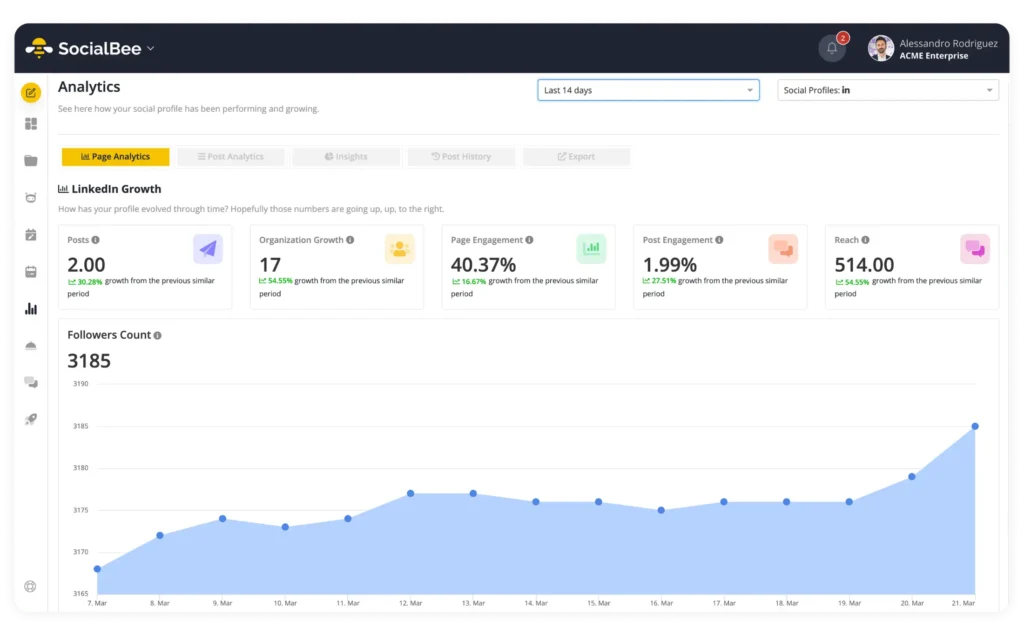
Use SocialBee’s Analytics to check your past account and content performance before setting new targets. You can compare results across your connected accounts and use that social media data to set goals based on how your pages actually perform.
3. Turn your goal into a SMART objective
Once you know what you want to improve and where you’re starting, make the objective SMART: specific, measurable, achievable, relevant, and time-bound.
Take “increase engagement.” Here’s how you could make it SMART:
- Specific: Increase engagement on organic LinkedIn posts.
- Measurable: Move the average engagement rate from 3.2% to 4%.
- Achievable: The account has already reached 3.8% during stronger months.
- Relevant: LinkedIn is an important channel for reaching prospective B2B customers.
- Time-bound: Hit the target by the end of Q4.
Put it together, and you get: Increase average LinkedIn engagement rate from 3.2% to 4% by December 31, 2026.
That’s a target you can actually work toward to measure success.
4. Choose the right KPIs
Next, decide which numbers will tell you whether you’re making progress. Keep the list focused on the outcome you want.
For brand awareness, you might track reach, impressions, and share of voice. For lead generation, look at qualified leads, form submissions, and cost per lead. For sales, social-attributed conversions, revenue, and conversion rate will tell you more.
Aim for two or three KPIs per objective so you know exactly what to watch.
5. Plan the tactics that will get you there
Now you can decide what you’ll actually do.
If you want to increase monthly Instagram reach by 20%, for example, you might publish more Reels, collaborate with relevant creators, or find better ways to distribute your content.
Depending on the goal, your tactics could also include paid ads, interactive content, community management, different posting times, or new content formats. Each tactic should have a clear reason for being there.
6. Check your progress and adjust
Don’t wait until the deadline to find out whether your plan worked. Check your main KPIs regularly and use what you learn to make adjustments along the way.
A simple rhythm is to check your numbers weekly, review your tactics monthly, and revisit the goal itself quarterly.
And if you’re falling behind, change the tactics before you change the goal. Test different topics, formats, posting times, or distribution methods first. If those changes still don’t improve your results, then you have a stronger reason to revisit the target.
10 examples of social media goals
Here’s a quick look at 10 common social media goals and the KPIs that can help you measure them:
Social media goal | Primary KPIs |
Increase brand awareness | Reach, impressions, share of voice |
Strengthen brand reputation | Brand mentions, sentiment, share of voice |
Increase community engagement | Engagement rate, comments, shares, saves |
Grow a relevant audience | Audience growth rate, new followers, non-follower reach |
Drive website traffic | Social referral traffic, link clicks, CTR |
Generate qualified leads | Lead submissions, qualified leads, cost per lead |
Increase conversions and revenue | Conversions, revenue, conversion rate, ROAS |
Build thought leadership | Qualified engagement, earned mentions, citations |
Improve social customer service | Response time, resolution rate, CSAT |
Support recruitment and employer branding | Applications, source of hire, applicant quality |
Now, let’s look at what each goal could mean for your business and how you can work toward it.
1. Increase brand awareness
Best for: Businesses that want to increase brand visibility and reach more of their target audience.
SMART goal example: Increase average monthly Instagram reach by 25% over the next six months.
KPIs to track: Reach, impressions, share of voice, branded search volume, and profile visits.
Tactics that can help:
- Create more shareable content.
- Experiment with high-reach formats such as short-form video.
- Collaborate with relevant creators.
- Use paid ads to reach new audiences.
Brand awareness matters when potential customers don’t know you yet. The aim is to make your brand more visible and recognizable to the people you eventually want to turn into customers.
2. Strengthen brand reputation
Best for: Businesses that want to improve how customers and their wider industry perceive their brand.
SMART goal example: Increase positive brand mentions by 15% and reduce unanswered negative mentions to below 5% over the next six months.
KPIs to track: Brand sentiment, positive and negative mentions, share of voice, and response rate.
Tactics that can help:
- Use social listening to follow conversations about your brand.
- Respond to positive and negative feedback.
- Address recurring customer complaints.
- Share customer stories and other proof points that build trust.
Unlike awareness, this goal isn’t about how many people know you. It’s about what people think and say once they do.
Social media also plays a direct role in how people discover new brands and products. According to DataReportal’s Digital 2025 Global Overview Report, 29.7% of internet users discover new brands, products, and services through ads on social media. That makes reach and visibility useful signals when your goal is to introduce your brand to more potential customers.
3. Increase community engagement
Best for: Brands that want more meaningful interaction with the people already seeing their content.
SMART goal example: Increase the average Instagram engagement rate from 2.8% to 3.5% by the end of Q4.
KPIs to track: Engagement rate, comments, shares, saves, replies, and active community members.
Tactics that can help:
- Ask questions your audience actually wants to answer.
- Create polls and other interactive content.
- Reply to comments and start conversations.
- Give followers opportunities to contribute ideas or opinions.
Look beyond likes when you measure engagement. Comments, shares, saves, and conversations tell you much more about how actively users interact with your brand.
4. Grow a relevant audience
Best for: Businesses that want to reach more people who match their ideal customer profile.
SMART goal example: Grow your LinkedIn audience by 15% over six months while maintaining or improving your current engagement rate.
KPIs to track: Audience growth rate, new followers, follower demographics, non-follower reach, and engagement rate.
Tactics that can help:
- Create content around the problems your target audience cares about.
- Collaborate with accounts that reach similar audiences.
- Improve how you distribute your content.
- Promote your social media pages through your website, email, and other channels.
The word relevant matters here. More Instagram followers or LinkedIn followers aren’t automatically better if those people have little interest in your business.
5. Drive website traffic
Best for: Businesses that use their website to educate visitors, collect sign-ups, book demos, or sell products.
SMART goal example: Increase monthly social referral traffic to your website by 20% over the next quarter.
KPIs to track: Social referral sessions, link clicks, CTR, engaged sessions, and landing page visits.
Tactics that can help:
- Share useful website content on the right social platforms.
- Write stronger calls to action.
- Optimize the links in your social profiles.
- Create posts that give people a clear reason to visit your website.
Tools such as Google Analytics can help you see what visitors do after they leave a social platform and arrive on your site.
6. Generate qualified leads
Best for: Businesses that want social media to contribute directly to their sales pipeline.
SMART goal example: Generate 100 qualified demo requests from social media over the next quarter while keeping cost per lead below $50.
KPIs to track: Qualified leads, form submissions, demo requests, lead conversion rate, and cost per lead.
Tactics that can help:
- Promote lead magnets that solve a specific customer problem.
- Improve your landing pages and lead forms.
- Run lead-generation campaigns.
- Retarget people who have already shown interest in your business.
The important word here is qualified. More email sign-ups aren’t necessarily better if the people signing up are unlikely to become customers.
7. Increase conversions and revenue
Best for: Businesses that can connect social media activity to purchases, subscriptions, or another revenue-generating action.
SMART goal example: Increase monthly revenue attributed to social media by 15% over the next six months.
KPIs to track: Social-attributed conversions, revenue, conversion rate, average order value, and ROAS.
Tactics that can help:
- Promote products to high-intent audiences.
- Retarget previous website visitors.
- Use customer reviews and other social proof.
- Test promotional posts and paid campaigns.
- Make the path from social media to purchase as simple as possible.
Social media won’t always get the final click before a sale. Someone might discover you on Instagram and return through Google days later, so look at the wider customer journey when you measure social media success.
A useful way to decide what deserves paid promotion is to look at what already performs well organically. As Gary Vaynerchuk, serial entrepreneur, Chairman of VaynerX, CEO of VaynerMedia, and Creator and CEO of VeeFriends, explains: “You should always post every piece of content you make for a sale or an ad organically first. If it does well in views compared to your norm, that’s what you start running media on.”
And social media can contribute directly to purchases. EMARKETER reports that 30.9% of consumers worldwide made a purchase through a social platform in the previous year.
8. Build thought leadership
Best for: B2B brands, founders, consultants, and experts that want to become trusted sources in their industry.
SMART goal example: Increase monthly shares and saves on expert-led LinkedIn content by 25% over the next six months.
KPIs to track: Qualified engagement, shares, saves, earned mentions, citations, and relevant inquiries.
Tactics that can help:
- Share original insights instead of repeating common advice.
- Add your perspective to relevant industry trends.
- Turn internal expertise into useful social media content.
- Publish original research, data, or lessons from your experience.
Thought leadership isn’t about posting generic advice more often. Give people useful expertise or a perspective they can’t get from every other account in their feed.
Thought leadership can also influence people who aren’t publicly engaging with your content. The 2025 Edelman-LinkedIn B2B Thought Leadership Impact Report, based on a survey of nearly 2,000 professionals, found that “hidden buyers” involved in B2B purchase decisions actively consume and evaluate thought leadership. That means visible engagement alone doesn’t capture the full impact of expert content.
9. Improve social customer service
Best for: Businesses whose customers use social media to ask questions, report problems, or request support.
SMART goal example: Reduce average social media response time to under two hours and maintain a customer satisfaction score above 90% by the end of Q4.
KPIs to track: Average response time, resolution time, resolution rate, response rate, and customer satisfaction score (CSAT).
Tactics that can help:
- Monitor comments, mentions, and direct messages consistently.
- Set clear response-time expectations.
- Create a process for escalating more complex problems.
- Keep answers to common questions easy for your team to access.
Social customer service can influence buying decisions, too. Emplifi found that 57% of consumers had contacted a brand through social media for customer service, while 86% said they were more likely to purchase from brands that respond quickly to questions on social media.
10. Support recruitment and employer branding
Best for: Businesses that want to attract qualified candidates and show potential hires what working for the company is actually like.
SMART goal example: Increase qualified job applications originating from social media by 20% over the next six months.
KPIs to track: Social-attributed applications, source of hire, applicant quality, careers page traffic from social, and engagement with employer-brand content.
Tactics that can help:
- Share employee stories and experiences.
- Show what different roles and teams actually do.
- Highlight your company culture and values.
- Promote relevant open positions.
- Answer common questions candidates have before applying.
This gives social media a clear job in your recruitment strategy without turning your feed into a stream of job ads. The goal is to help the right candidates understand your company and decide whether they want to work there.
Social media goals by platform
You don’t need a completely different set of social media marketing goals for every platform. The business goal can stay the same while each network plays a different role in helping you reach it.
The role of each platform then determines which KPIs you pay the most attention to.
Platform | Goals it commonly supports | Useful KPIs |
Thought leadership, B2B lead generation, recruitment | Qualified engagement, lead form submissions, profile views, applications | |
Brand awareness, community engagement, audience growth, sales | Reach, shares, saves, profile visits, conversions | |
TikTok | Brand awareness, discovery, community building | Views, completion rate, shares, non-follower reach |
Community building, local awareness, customer service, sales | Reach, comments, Messenger conversations, conversions | |
YouTube | Brand awareness, education, consideration | Views, watch time, subscribers, website clicks |
Discovery, website traffic, ecommerce | Pin impressions, saves, outbound clicks, conversions | |
X (Twitter) | Real-time engagement, brand reputation, customer service | Mentions, replies, response time, link clicks |
Google Business Profile | Local visibility, website traffic, customer engagement | Search views, website clicks, calls, direction requests |
Start with the result your business needs, then decide what role each of your social media platforms can realistically play. You may find that one platform is best for reaching new people while another is better at turning existing interest into leads or sales. That’s more useful than expecting every social media channel to deliver the same results.
Frequently asked questions
Should you use the same social media goals across every platform?
Not necessarily. Your overall business goal can stay the same, but each platform can contribute differently to the social media strategy. You might use TikTok to reach new audiences, LinkedIn to build credibility, and Instagram to keep your brand visible and engaged with its community.
Can you have more than one KPI for a social media goal?
Yes. Most goals need a small group of KPIs to give you a complete picture. For example, measuring brand awareness through reach alone can miss whether visibility is growing consistently, so you may also track impressions, share of voice, and branded search activity.
What should you do if you don’t reach a social media goal?
Start by looking at why you missed it rather than immediately lowering the target. Check whether your assumptions were realistic, whether you had enough resources, and which tactics underperformed. A missed goal can still give you useful data for setting a better target next time.
Should organic and paid social media have separate goals?
They can share the same broader goal, but it often makes sense to give them separate social media objectives and KPIs. For example, organic content might support community engagement while paid campaigns focus on generating leads, even when both contribute to the same marketing campaign.
Can social media goals change during the year?
Yes. Goals should change when your business priorities, audience behavior, available resources, or market conditions change significantly. The important thing is to make the change intentionally and document why, rather than constantly moving the target because short-term results fluctuate.
Who should be responsible for setting social media goals?
Social media managers shouldn’t have to set goals in isolation. Marketing teams and business leaders should agree on the business outcome social media is expected to support, while the people managing the channels can determine what social media can realistically contribute and how that progress should be measured.
Set goals you can actually measure
Social media works better when you know what success is supposed to look like. With clear goals in place, it’s easier to stay focused, make smarter decisions, and show what your work is contributing to the business.
SocialBee is a social media management tool that can help you take it from there by keeping your content planning, publishing, and performance tracking in one place.